.jpg)
Bitcoin’s Price Volatility Explained & Why It’s Normal
Bitcoin is volatile, but that volatility has a story. Learn what drives Bitcoin’s price swings and why they’re typical for an emerging monetary asset.
Bitcoin’s Price Volatility Explained and Why It’s Normal
Bitcoin is often described as volatile, and if you've followed its price for even a short time, you understand why. Its volatility might be startling, especially for those new to digital assets.
But Bitcoin’s volatility is illustrative of how early-stage assets often mature, gain liquidity, and reach broader adoption. Gold also experienced large price swings when it began trading freely in 1971, and many large technology stocks saw dramatic ups and downs in their early years.
This article breaks down exactly what drives Bitcoin's price swings, how analysts measure Bitcoin volatility, and why understanding these dynamics can help put short-term movements into perspective.
Whether you’re researching Bitcoin for the first time or looking to deepen your knowledge, this guide offers a clear, grounded look at one of the most discussed topics in the space.
Key Takeaways
- Bitcoin's volatility stems from identifiable factors: limited supply, whale activity, regulatory developments, news sentiment, and macroeconomic conditions.
- While Bitcoin remains more volatile than traditional assets like gold and equities, its volatility has been declining over time as the market matures.
- Understanding the drivers of volatility can help frame short-term price movements within a longer-term context.
- Drawdowns of more than 50% have been relatively common throughout Bitcoin's history.
- Volatility is common in relatively young assets. Many emerging assets experience swings as their markets mature, liquidity deepens, and participation broadens.
A High-Level Look at What Drives Bitcoin Volatility
Bitcoin follows the same economic principles as any tradable asset: The price moves when buyers and sellers disagree on value. When more people want to buy than sell, prices rise. When sellers outnumber buyers, prices fall. What makes Bitcoin different is often the speed and magnitude of these shifts.
Unlike traditional markets with decades of established pricing models, Bitcoin is still relatively young, so market sentiment can change quickly. News, regulatory developments, and macroeconomic signals can all influence how participants view Bitcoin at any given moment.
Trust plays a significant role: When participants feel confident about Bitcoin’s future, they might hold or accumulate, but when uncertainty creeps in, selling often accelerates. This dynamic creates a feedback loop where price movements themselves influence sentiment, which in turn drives further price action.
The Core Drivers of Bitcoin’s Volatility
Bitcoin's price movements aren't random. They're often tied to identifiable factors that, once understood, help explain why the asset behaves the way it does. Here are some of the primary forces that shape Bitcoin's volatility.
Limited Supply and Shifting Demand

Bitcoin's fixed supply of 21 million coins is one of its defining characteristics and a primary driver of its volatility. Unlike fiat currencies, which central banks can theoretically print without limit, Bitcoin’s supply is predetermined and unchangeable.
This scarcity means that when demand increases, there's no way to produce more Bitcoin to meet it. Even relatively small inflows of capital can move the price a lot compared to larger, more liquid markets like gold or stocks. Conversely, when demand drops, prices can fall quickly because the supply side offers no cushion.
The impact of supply constraints becomes larger during adoption cycles, which are periods when new groups of participants enter the market. These waves of demand, meeting an inelastic supply, have historically coincided with some of Bitcoin's most dramatic price increases.
Bitcoin Whales

"Whales" are entities that hold large amounts of Bitcoin and can have an outsized impact on price. If a whale sells a significant portion of their holdings, the market may struggle to absorb the volume, which can cause more volatility than normal.
Large sell orders can also trigger cascading effects. Automated trading systems may execute stop-loss orders or liquidate leveraged positions, amplifying the initial price drop and potentially causing a sharp decline that’s disproportionate to the actual news driving it.
One notable example occurred in August 2025, when a dormant whale sold approximately $2.7 billion worth of Bitcoin. The transaction triggered a $4,000 price drop and led to more than $715 million in liquidations across exchanges.
Even when whales don't sell, their movements can still influence market sentiment. Traders closely monitor large Bitcoin wallet addresses with tools like GlassNode or Whale Alert, and transfers to exchanges are often interpreted as potential sell signals. This sometimes triggers preemptive selling by smaller holders.
Regulation and Policy Announcements

Bitcoin operates in a global regulatory environment that’s always changing. Government statements, regulatory rulings, tax guidance, and policy decisions can all influence large price reactions, sometimes before the full implications are even clear.
One of the most significant regulatory developments in recent years was the U.S. Securities and Exchange Commission's approval of spot Bitcoin exchange-traded funds (ETFs) in January 2024. This decision, which came after more than a decade of applications and rejections, opened the door for mainstream U.S. investors to gain Bitcoin exposure through traditional brokerage accounts.
The market's response illustrated how regulatory clarity can affect price appreciation: Bitcoin rose from approximately $24,900 when BlackRock first filed its ETF application to over $46,000 following its approval. As of late 2025, BlackRock held more than 775,000 Bitcoin, or roughly 3.7% of the total supply.
The relationship between regulation and volatility often cuts both ways. When rules are clear, volatility often falls, but when a new rule appears, the market can move fast. As countries continue to clarify and formalize their crypto rules, policy announcements are likely to remain an important factor in short-term Bitcoin volatility.
News Cycles and Social Sentiment

Bitcoin's price is highly responsive to public perception, and in the age of social media, sentiment can shift rapidly. Activity on platforms like X can coincide with sharp price movements as information and opinions spread quickly.
Public commentary doesn’t just reflect price changes; it often reacts to them in real time. Rapid sharing and commentary can amplify short-term movements, even when no new fundamental information has emerged.
The pattern typically works like this:
- Positive news may generate optimistic posts and coverage, which can coincide with increased trading activity and upward price momentum.
- Negative news can create the opposite effect. Fear might spread quickly, selling pressure can increase, and prices may drop sharply over short periods.
Understanding this feedback loop helps explain why Bitcoin's price can sometimes seem to overreact to headlines.
Geopolitical and Economic Macro Events

Like other financial assets, Bitcoin’s price reacts to macroeconomic forces such as interest rate decisions, inflation data, and geopolitical events. U.S. Federal Reserve policy has become especially influential.
Bitcoin’s price is frequently discussed alongside inflation concerns due to its fixed supply of 21 million BTC and halving events that limit new issuance. This design contrasts with fiat currencies that can expand freely.
When the Fed cuts interest rates, liquidity often increases, and investors tend to move more capital into risk assets, including Bitcoin. That said, the link isn’t linear. Expectations, positioning, and timing can lead to short-term moves that seem to contradict the broader trend.
One study found that a 1% increase in money supply has historically aligned with roughly a 2.65% rise in Bitcoin’s price. This isn’t a guaranteed or consistent long-term effect, but it shows that, at least historically, inflation has played a key role in Bitcoin’s performance.
Geopolitical developments matter, too. Wars, trade tensions, and sanctions can shift global risk appetite, often increasing volatility across markets. Bitcoin’s borderless design means it can react to events happening anywhere in the world.
How Bitcoin's Volatility Is Measured
When analysts talk about Bitcoin’s volatility, they’re describing how much its price moves up and down over time. A common way to measure this looks at how far prices stray from their average during a given period.
Volatility is often shown as a yearly percentage. For example, if Bitcoin’s one-year volatility is 60%, it means its price has typically moved about that much away from its average price over a year, based on past daily, weekly, or monthly changes.
It doesn’t mean Bitcoin will gain or lose 60% in a year. It simply describes how large its price swings have been in the past.
To put Bitcoin's volatility in context: As of late 2025, Bitcoin's annualized volatility stands at approximately 52%, compared to 15% for gold. This means Bitcoin's price swings are about 3.5 times larger than those of gold.
There's also the Bitcoin Volatility Index, which measures implied volatility based on options market pricing. Unlike historical volatility, which looks backward, implied volatility reflects traders' expectations about future price movements. When the volatility index rises, it signals that market participants expect larger price swings ahead, but not necessarily upward.
Understanding how volatility is measured helps explain why Bitcoin’s price can move sharply over short periods. High volatility doesn’t describe whether an asset is “good” or “bad”; it simply indicates that prices have tended to fluctuate more compared to less volatile markets.
Bitcoin Volatility Over Time
One notable trend in Bitcoin's history is how its volatility has changed as the market has evolved. In 2014, there were periods when Bitcoin's 90-day volatility exceeded 200%. By 2023, that same measure had fallen below 50%.
This makes sense when viewed through the lens of market maturation and is common among assets. If the market cap of a stock is $1 billion, a $50 million buy/sell order affects the price much more than if the market cap is $100 billion.
As Bitcoin's market capitalization has grown from millions to trillions of dollars, the relative impact of any single transaction has diminished. Although the price is still relatively volatile, more participants, deeper liquidity, and improved market infrastructure have all contributed to a more stable price today than 10 years ago.
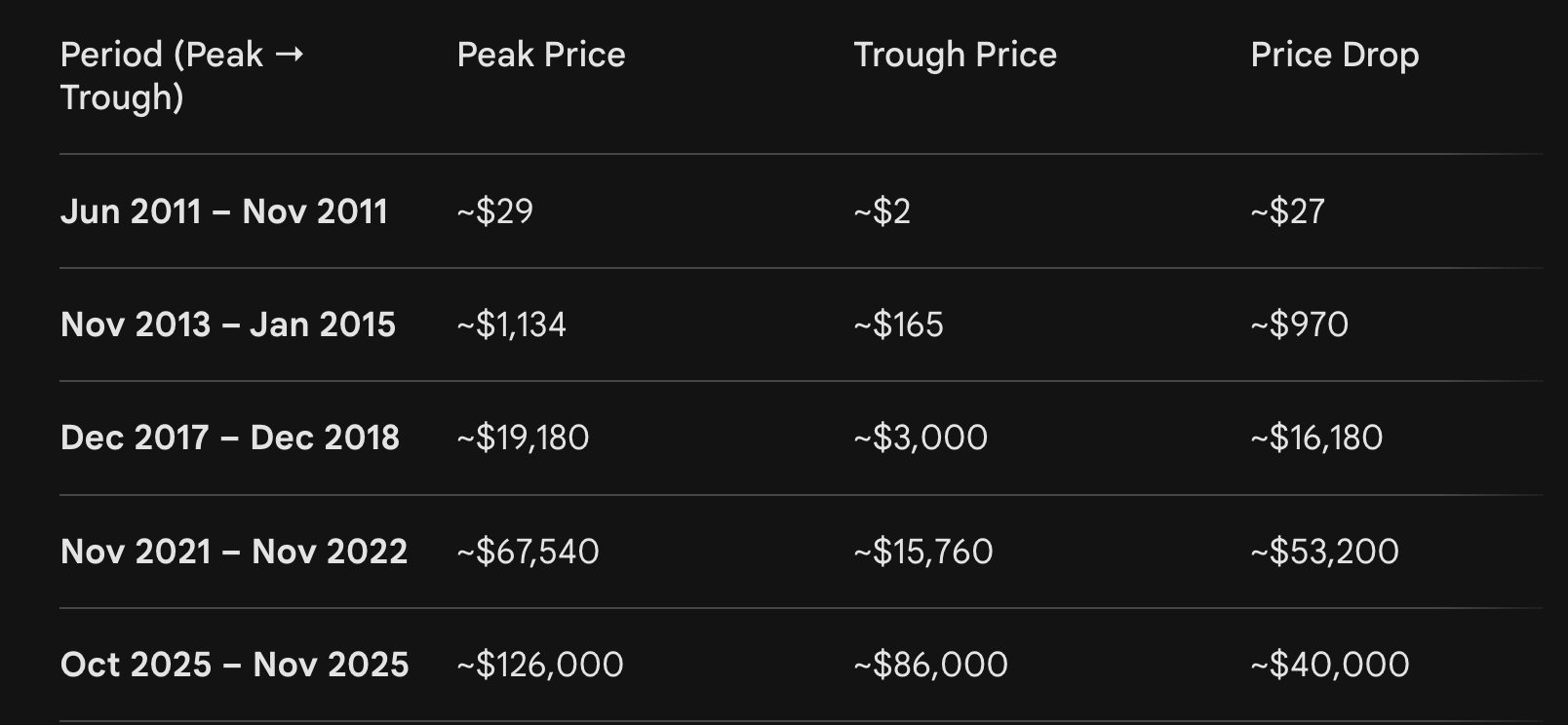
However, although the price is more stable, significant pullbacks remain a part of Bitcoin and the wider cryptocurrency ecosystem’s profile.
The chart below shows some of Bitcoin’s largest drawdowns, including the most recent at the end of 2025, and how it compares to others.
Understanding and Dealing with Bitcoin's Volatility
For those new to Bitcoin, volatility can feel unsettling. Headlines about dramatic price swings may raise questions about risk and stability. However, taking time to understand what drives volatility—and how it’s commonly interpreted—can help put these movements in perspective.
Volatility Doesn't Always Equal Risk
In traditional finance (often referred to as TradFi in the crypto space), volatility is commonly used as a proxy for risk. Higher volatility means less predictable returns, which can be uncomfortable for those with shorter time horizons or lower risk tolerance. But volatility is simply a measure of price movement, both upward and downward.
Despite its dramatic swings, Bitcoin averaged annualized returns of approximately 99% from August 2011 to July 2025 compared to 14.7% for the S&P 500, albeit with higher levels of volatility along the way.
It's also worth noting that Bitcoin's volatility is increasingly comparable to some widely held investments. Many familiar mega-cap technology stocks, including companies like Nvidia, Tesla, and Meta, have experienced high levels of volatility at various points during their growth. Volatility and long-term appreciation can coexist.
In other words, volatility isn't unique to digital assets.
Time Horizons Can Change How Volatility Looks
How you feel about volatility depends heavily on how you view it. Daily or weekly price charts can make movements appear dramatic and chaotic. Monthly or yearly charts often reveal clearer trends and patterns that get lost in the noise of shorter timeframes.
Many long-term Bitcoin holders, including major institutions and publicly traded companies, approach the asset with multi-year horizons. From this perspective, short-term volatility becomes less relevant.
This longer-term view doesn't eliminate volatility, but it does change its significance. A 30% pullback looks less impactful when viewed as part of a multi-year uptrend than when examined in isolation. Across asset classes, from equities to commodities to digital assets, volatility tends to look different depending on the window through which it’s viewed.
Education Can Reduce Uncertainty
One of the most effective ways to approach Bitcoin's volatility is through learning more about it. When you understand why prices move, the movements themselves (if not their exact timing) become easier to contextualize.
Knowledge also helps separate signal from noise: Not every headline warrants a reaction, and not every price swing reflects a fundamental change. Having a sense for Bitcoin’s underlying mechanics and historical volatility helps distinguish between routine marketing fluctuations and changes driven by new information.
ABTC's Strategy: Focusing on Bitcoin's Long-Term Value
Bitcoin's price swings tend to be influenced by identifiable, explainable factors: supply constraints, market structure, regulatory developments, sentiment shifts, and macroeconomic conditions. While the magnitude of these movements can be significant in the short term, they tend to be interpreted differently by participants with longer time horizons.
American Bitcoin Corp (Nasdaq: ABTC) is building America's Bitcoin infrastructure backbone with a long-term focus. ABTC and its investors are aligned around Bitcoin’s fixed supply, decentralized architecture, and growing role in the global financial system.
Understanding Bitcoin’s volatility doesn't eliminate it, but it can help explain the why behind sharp price movements. Viewed through this lens, volatility reflects how markets process new information and changing conditions rather than something unique or unexpected. This perspective is central to how long-term participants approach Bitcoin as a developing global financial network.
Learn more about ABTC’s mission.
Bitcoin Volatility FAQs
What are the main factors that cause big swings in Bitcoin's price?
Bitcoin’s price movements are often discussed in relation to several factors, including its limited supply meeting variable demand, large holder ("whale") trading activity, regulatory announcements, news and social media sentiment, and broader macroeconomic conditions like interest rate changes and inflation data.
How do market sentiment and news headlines impact Bitcoin volatility?
News and shifts in sentiment can coincide with rapid buying or selling as market participants react to new information. Positive developments—such as institutional adoption or favorable regulation—may be associated with higher prices, while negative news may be linked to selloffs and price drops. Social media platforms can amplify these effects by spreading information quickly across global markets.
Is Bitcoin's volatility decreasing as adoption grows?
Yes. Historical data shows a clear downward trend in Bitcoin's volatility over time. In its early years, 90-day volatility regularly exceeded 100%, and by 2023, this measure had fallen below 50%.
How should long-term investors think about short-term Bitcoin price drops?
Bitcoin’s price behavior can appear very different depending on the time frame. Short-term charts may highlight sharp fluctuations, while longer-term views can place those movements within broader historical patterns. This difference in perspective is common across many asset classes and helps explain why Bitcoin’s volatility can be interpreted in different ways.
Can Bitcoin still be considered a store of value if its price is volatile?
Bitcoin’s volatility and its fixed-supply design are often discussed together, particularly when comparing it to other assets. While its price has experienced significant short-term fluctuations, some participants focus on its longer-term characteristics, such as its supply structure and network design. How to weigh these factors varies widely among individuals and institutions.
How do traders and institutions manage risk around Bitcoin volatility?
Common approaches include position sizing (allocating a smaller percentage of a portfolio to volatile assets), diversification, regular rebalancing, and dollar-cost averaging (investing fixed amounts at regular intervals rather than attempting to time the market). Some market participants also use derivatives and hedging strategies.
How can businesses holding Bitcoin on their balance sheet account for volatility risk?
Businesses typically manage Bitcoin volatility through treasury policies that define allocation limits, holding periods, and risk parameters. Many corporate holders account for Bitcoin as a long-term balance-sheet holding rather than a trading position, which places price volatility within a broader treasury framework. Clear accounting policies and disclosure practices also help manage stakeholder expectations.
Sources
- “The Fed Cuts Rates Again: What This Macro Shift Means for Crypto Into 2026.” Bitget. https://www.bitget.com/academy/fed-interest-rate-december-2025-impact
- “Statement on the Approval of Spot Bitcoin Exchange-Traded Products.” SEC. https://www.sec.gov/newsroom/speeches-statements/gensler-statement-spot-bitcoin-011023
- “25 Years on; Lessons from the bursting of the technology bubble.” Goldman Sachs. https://www.goldmansachs.com/pdfs/insights/goldman-sachs-research/25-years-on-lessons-from-the-bursting-of-the-tech-bubble/redaction.pdf
- “Don’t Learn the Wrong Lessons from the Dot Com Crash.” Intrinsic Investing. https://intrinsicinvesting.com/2021/03/05/dont-learn-the-wrong-lessons-from-the-dot-com-crash/
- “Spot Bitcoin ETF Approval Was The Most Important Moment In 2024.” Nasdaq. https://www.nasdaq.com/articles/spot-bitcoin-etf-approval-was-most-important-moment-2024
- “Bitcoin vs S&P 500: historical performance.” Curvo. https://curvo.eu/backtest/en/compare-indexes/bitcoin-vs-sp-500?currency=usd
- “Bitcoin’s dwindling volatility signals maturity.” Kaiko Research. https://research.kaiko.com/insights/bitcoin-volatility-dwindles-as-crypto-assets-mature
- “Bitcoin Price Drawdown from ATH.” Newhedge. https://newhedge.io/bitcoin/price-drawdown
- “Sentiment Matters for Cryptocurrencies: Evidence from Tweets.” Multidisciplinary Digital Publishing Institute. https://www.mdpi.com/2306-5729/10/4/50
“Bitcoin on the brink: What investors need to know.” Wellington Management. https://www.wellington.com/en/insights/bitcoin-on-the-brink