
Bitcoin and Inflation: Understanding the Hedge Narrative
Is Bitcoin really an inflation hedge? Explore how Bitcoin compares to cash and gold, and why some view it as a response to rising prices.
Bitcoin and Inflation: Understanding the Hedge Narrative
Inflation reduces purchasing power over time. When prices rise faster than incomes, everyday purchases start to feel much heavier on your wallet.
What does Bitcoin inflation have to do with any of this? And beyond the sticker shock at the grocery store, what does inflation really mean for your money over time?
The core issue is straightforward: Each dollar buys less with each passing year. The coffee that once cost a quarter now costs several dollars. By contrast, Bitcoin operates with a capped supply, which has led some observers to question whether it could serve as a long-term store of value—though the answer remains far from settled.
The idea of buying Bitcoin to protect yourself from inflation is a narrative and not a conclusion. In this piece, we'll break down what inflation is and why it exists, what it means for something to be a "hedge," and explore both sides of the Bitcoin vs. inflation debate. We'll also share a straightforward way to explore the numbers yourself.
Key Takeaways
- Inflation reduces the purchasing power of money over time, meaning each dollar buys less as prices rise.
- A hedge is an asset that is intended to hold its value, or sometimes increase in value, during periods when other assets or currencies are losing purchasing power.
- Bitcoin's fixed supply of 21 million coins is the primary reason some people view it as a potential hedge against inflation.
- Bitcoin’s price volatility is significant, meaning short-term movements don't always track with inflation metrics like the Consumer Price Index (CPI).
- Academic research on whether Bitcoin functions as an inflation hedge has produced mixed results, with findings varying by time period and methodology.
- The case for Bitcoin as an “inflation hedge” tends to appear stronger when viewed over longer time horizons than in month-to-month comparisons.
What Is Inflation?
Inflation measures how much more expensive goods and services become over a period of time. It’s commonly tracked on a yearly basis. When economists talk about inflation, they're really talking about purchasing power. In other words, how much stuff your money can buy.
Here's a simple example: In 1970, the average cup of coffee in the United States cost about 25 cents. As of August 2025, it’s up to over $3.50.
That's inflation at work. Over time, the dollar has lost some of its buying power, meaning you need more of the currency to purchase the same cuppa joe.
That’s why holding large amounts of cash can feel like watching ice melt. If inflation runs at 3% annually and a savings account pays 1%, the balance’s purchasing power is quietly shrinking. The numbers in the account stay stable, but those numbers don’t stretch as far in the real world.
What Is a Hedge?
A hedge, in simple terms, is an asset that tends to hold its value—or sometimes even appreciate—when other assets or currencies are losing their purchasing power.
Gold has traditionally been viewed this way, and real estate is another common example. The idea is that these assets have characteristics, such as limited supply or real-world utility, that help them retain purchasing power, even when the currency used to price them is diluted.
But a hedge doesn't have to move in perfect opposition to inflation. It simply needs to hold up reasonably well during inflationary periods.
In simplest terms, calling something a hedge isn’t about certainty. It’s more about comparison. It’s about whether the hedge tends to hold value better than other options during inflation.
Why People Think Bitcoin Could Be an Inflation Hedge
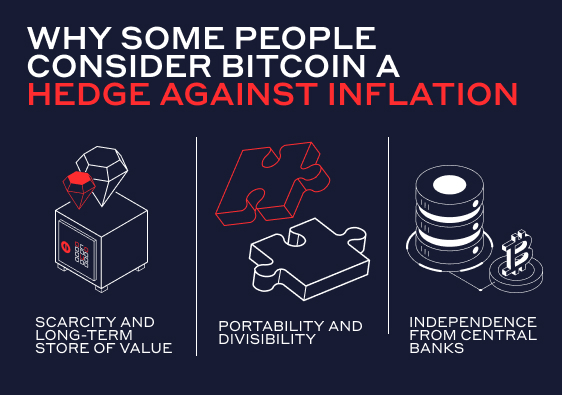
Several characteristics of Bitcoin have led some observers to compare it with traditional stores of value. These arguments tend to focus on Bitcoin’s structure and design rather than its short-term price behavior.
Scarcity and Long-Term Store of Value
A “store of value” is something people use to preserve purchasing power over time. You might think of it as a way to hold value while not actively using an asset. Gold and real estate have historically filled this role for many people.
Bitcoin has a fixed supply of 21 million coins, while traditional currencies, like the dollar, have a potentially unlimited supply because the government can print more at will. Some observers view Bitcoin’s scarcity as an argument for why it could be considered a hedge against inflation.
A similar comparison is real estate. There’s only so much land on earth, which means there’s a fixed and limited supply. We cannot create more land as demand increases, which is why real estate tends to be viewed as a store of value.
That said, Bitcoin’s price history reflects significant volatility. The digital asset has experienced dozens of pullbacks of 10% or more, with those declines averaging about a 30% drop from the top to the bottom. A pullback, also called a drawdown, is the percentage drop in price from a recent high to a temporary low.
Because of this sort of volatility, thinking of Bitcoin as a store of value makes the most sense over long time horizons. Short-term price movements can be sharp and unpredictable, and any discussion of Bitcoin in this context must account for that reality.
Portability and Divisibility
Unlike physical gold, Bitcoin is entirely digital and can be moved and stored without the logistical constraints associated with physical assets. Holders can access their Bitcoin anywhere in the world as long as they have an internet connection and control of their private keys.
Bitcoin is also divisible down to one hundred millionth of a Bitcoin, a unit known as a Satoshi, allowing for ownership in small denominations.
These usability traits don't establish Bitcoin as an inflation hedge on their own, but they do help explain why some people see Bitcoin as a practical tool for preserving value across borders and over long periods of time.
Independence from Central Banks
Bitcoin isn't issued by any government and doesn't rely on central bank policy decisions. Its inflation rate—the pace at which new coins are added to the system—follows established rules that cannot be changed at the discretion of any single entity.
For some people, this makes Bitcoin a kind of “policy hedge.” If they lose confidence in how a monetary policy is being managed (e.g. excessive money printing), they may prefer an asset whose rules are fixed and transparent.
The argument is not that Bitcoin guarantees returns. It’s that how Bitcoin works (with fixed, transparent supply rules) offers predictability. That’s a feature some people may value in times when trust in traditional institutions is under scrutiny.
Why People Think Bitcoin May Not Be an Inflation Hedge
Just as there are arguments in favor, there are also reasons some observers remain unconvinced that Bitcoin is a true hedge against inflation. These critiques focus on Bitcoin’s price behavior, history, and measurement challenges.
Volatility
Bitcoin’s volatility has been dramatic throughout its history. Some observers classify it as a “risk asset” because of its bigger ups and downs relative to traditional assets. They might also argue that its movements often seem driven by investor sentiment, liquidity, and broader market trends rather than inflation data specifically.
In practice, Bitcoin can drop sharply even during periods of high inflation. That complicates the idea of Bitcoin as a short-term hedge, particularly if you’re looking for something that reliably protects purchasing power in the short term. That said, Bitcoin’s volatility has shown signs of decreasing over time as the market has matured.
While Bitcoin was the best-performing major asset in eight of 11 years between 2015 and 2025, it was also the worst performer in two of the other three years. That illustrates both the potential and the risk.
Lack of Intrinsic Value
“Intrinsic value” refers to an asset's inherent worth based on its fundamental properties or uses. Gold, for example, has applications in jewelry and electronics. But some critics argue that Bitcoin, as a purely digital asset, lacks this kind of tangible utility.
The counterargument: Roughly 85% of mined gold is held for speculative or investment purposes rather than industrial use. And that, some contend, is part of the reason gold’s price rose 65% in 2025. Gold's value, like Bitcoin's, largely derives from a collective agreement that it's worth something.
Different Definitions of “Inflation”
One common source of confusion is that the phrase “Bitcoin inflation” often refers to something completely different from consumer inflation.
Consumer inflation, measured by indexes like the Consumer Price Index (CPI), tracks rising prices in the broader economy. Bitcoin’s inflation rate refers to the pace of new coin issuance. In other words, how many new Bitcoins are being mined and added to circulation. These are distinct concepts.
Even with Bitcoin's supply growth slowing (the Bitcoin inflation rate in 2025 sits below 1% annually following the 2024 halving), its market price can still fall. Low supply growth doesn't automatically mean price stability. Demand matters, too.
So, Is Bitcoin a Hedge Against Inflation?
The short answer is that there is no consensus. Studies and analysts reach different conclusions. Looking at any Bitcoin vs. inflation chart reveals a complicated picture. There are periods where BTC significantly outpaced rising prices and stretches where it didn't.
Some research has found that Bitcoin tends to appreciate following positive inflation shocks, which would support the inflation-hedging narrative. However, the same research notes that Bitcoin prices decline during periods of heightened financial uncertainty, something that often accompanies inflationary periods. Gold, by contrast, has historically performed more consistently across both scenarios.
One way to frame it might be something like this: Bitcoin is a “possible long-term hedge,” not a short-term shield. Claims that Bitcoin is a proven inflation hedge in all circumstances are likely an oversimplification.
As with most investing, time horizon is perhaps the critical factor. Protecting purchasing power over years or decades is a different goal than responding to monthly inflation prints. The characteristics that make Bitcoin appealing to some as a long-term store of value—fixed supply, decentralization, global accessibility—don't necessarily translate to short-term stability.
What's clear is that Bitcoin occupies an unusual position in the bigger financial picture. It shares some characteristics with traditional inflation hedges like gold, but its relatively short history and higher volatility make it difficult to draw definitive conclusions.
How to Calculate Whether Bitcoin Beat Inflation
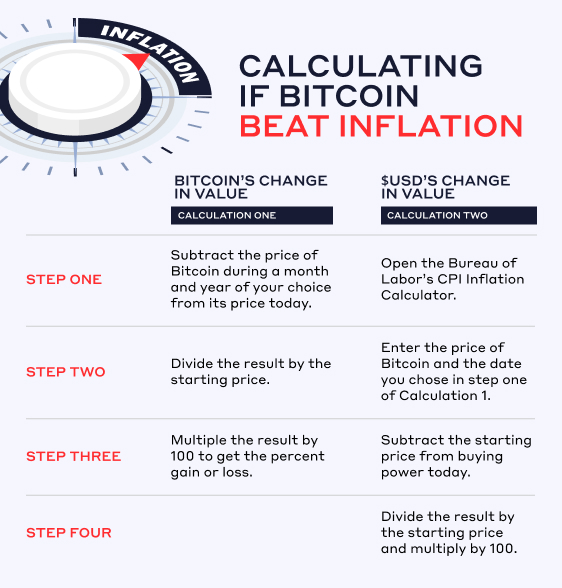
One way analysts evaluate the inflation-hedge narrative is by comparing Bitcoin’s historical price performance with changes in consumer prices over the same period. This sort of calculation could be referred to as a “Bitcoin inflation calculator,” and the process is relatively straightforward:
- Step 1: Find your starting and ending Bitcoin prices. Pick two dates. Say, when you first became interested in Bitcoin and today. Note the price on each date. Historical price data is available on numerous cryptocurrency tracking websites.
- Step 2: Calculate Bitcoin's percentage change. Subtract the starting price from the ending price. Then, divide the result by the starting price, and multiply by 100. This gives you the percentage gain or loss.
- Step 3: Find cumulative inflation for the same period. The U.S. Bureau of Labor Statistics (BLS) offers a CPI Inflation Calculator that simplifies this. In this example, you would enter the price of Bitcoin for the year you first became interested in it, and that month/year. Then you would enter today’s month/year. The calculator will tell you what your original amount would be worth in today’s dollars. Note: The CPI Inflation Calculator is not updated in real time, so recent monthly data may not be available yet.
- Step 4: Calculate the cumulative inflation rate. Subtract the starting price from the ending price produced by the calculator. Then, divide that number by the starting price, and multiply by 100. This gives you the cumulative inflation rate.
- Step 5: Compare. If Bitcoin’s percentage gain exceeds the cumulative inflation rate, it outpaced inflation during that period. If not, it did not beat inflation.
This is a very simplified approach that doesn’t account for factors like taxes or transaction fees, but it gives you a baseline for understanding whether Bitcoin has preserved purchasing power over a chosen time frame.
Bottom Line: The Case for Bitcoin as an Inflation Hedge
Bitcoin's scarcity narrative is one reason it continues to gain attention in the context of inflation. A hard-capped supply of 21 million coins, combined with a predictable issuance schedule and decentralized governance, gives it characteristics that differ fundamentally from fiat currencies.
Its digital nature makes it portable and divisible. With over 95% of all Bitcoin already mined and issuance continuing to slow, the supply side of the equation is increasingly constrained.
At the same time, Bitcoin's volatility remains significant, and its price doesn't consistently track consumer inflation metrics. Critics highlight the absence of intrinsic value and the potential for demand to shift for reasons unrelated to inflation.
The academic research is mixed, with results varying by time period and methodology. So, where does that leave us?
Bitcoin can be part of the inflation conversation, but it’s not a guaranteed inflation shield. The case is strongest when viewed through a long-term lens. If you’re new to this topic, understanding risk and time horizon is where to start. Bitcoin's behavior over the next decade may look quite different from its first 15 years as the market continues to mature and evolve.
ABTC is focused on building America’s Bitcoin infrastructure backbone that supports Bitcoin’s long-term growth and resilience. Learn more about our mission and how we're working to strengthen America's role in the growing digital asset space.
Bitcoin and Inflation FAQs
How is Bitcoin commonly described in the context of inflation and currency debasement?
Bitcoin is often described as “digital gold” in discussions about inflation. Many observers point to its fixed supply and decentralized nature as characteristics that differentiate it from fiat currencies, which can be expanded through central bank policies.
In what ways is holding Bitcoin different from holding cash during inflationary periods?
The key difference is supply dynamics. Cash can be created in unlimited quantities through monetary policy, which can dilute its value over time. Bitcoin has a hard cap of 21 million coins. However, Bitcoin also comes with price volatility that cash doesn't have.
How does Bitcoin compare to gold in discussions about inflation hedges?
Bitcoin and gold share scarcity as a key characteristic, but they differ in important ways. Gold has a centuries-long track record and some industrial utility. Bitcoin is newer and more volatile, but it offers advantages like easy portability and divisibility. Some research suggests gold performs better during periods of financial uncertainty, while Bitcoin’s price behavior appears more sensitive to inflation expectations.
What historical data is often cited when examining Bitcoin's performance during periods of rising inflation?
Analysts often point to the period from March 2020 through late 2021, when Bitcoin rose significantly as inflation concerns mounted. However, Bitcoin’s performance during the high-inflation period of 2022 was more mixed, leading to differing conclusions depending on which time frame is examined.
What are some of the main critiques of the idea that Bitcoin acts as an inflation hedge?
Critics primarily point to volatility. Bitcoin can experience large price swings that overwhelm any inflation-hedging benefits. Others note that Bitcoin often trades like a risk asset, moving in tandem with stocks rather than inversely to inflation. Bitcoin’s relatively short history makes it difficult to draw definitive conclusions.
How does Bitcoin's fixed supply contrast with central bank policies that expand the money supply?
Central banks can increase the money supply through various mechanisms, including quantitative easing (when central banks create money to support lending and economic activity) and adjusting interest rates. Bitcoin’s supply schedule is hard-coded into its protocol and cannot be altered by any single entity. This creates a fundamental difference in how each responds to economic conditions. The Bitcoin inflation rate in 2025 was under 1% and issuance continues to slow with each halving cycle.
How do individuals and businesses in high-inflation environments sometimes use Bitcoin in practice?
In countries experiencing severe currency devaluation, some individuals have reported using Bitcoin as a way to preserve savings outside the local currency system. Businesses have used it for cross-border transactions to avoid volatile exchange rates. However, regulatory environments vary significantly by country, and volatility remains a consideration even in these use cases.
Sources
- “What Is Inflation and What Does It Mean When It Goes Up or Down?” Yahoo! Finance Canada. https://ca.finance.yahoo.com/news/inflation-does-mean-goes-down-110000107.html
- "What is inflation?" McKinsey & Company. https://www.mckinsey.com/featured-insights/mckinsey-explainers/what-is-inflation
- “Where coffee prices are rising the most.” Axios. https://www.axios.com/2025/09/29/coffee-prices-rising-map
- "Store of Value." Investopedia. https://www.investopedia.com/terms/s/storeofvalue.asp
- "Understanding Satoshi: Bitcoin's Smallest Unit and Its Value." Investopedia. https://www.investopedia.com/terms/s/satoshi.asp
- "November 2025: What It Takes to HODL." Grayscale Research. https://research.grayscale.com/market-commentary/november-2025-what-it-takes-to-hodl
- "April 2024: Crypto Tailwinds, Macro Headwinds." Grayscale Research. https://research.grayscale.com/market-commentary/april-2024-crypto-tailwinds-macro-headwinds
- "How to fight inflation with Bitcoin." Proton. https://proton.me/blog/hedge-inflation-btc
- "Bitcoin Coin Report." Fidelity Digital Assets. https://www.fidelitydigitalassets.com/sites/g/files/djuvja3256/files/acquiadam/FDA%20Bitcoin%20Coin%20Report%20-%2012-06.pdf
- "Democracy in crisis: Trust in democratic institutions declining around the world." University of Southampton. https://www.southampton.ac.uk/news/2025/02/democracy-in-crisis-trust-in-democratic-institutions-declining-around-the-world.page
- "Bitcoin's Falling Volatility." Sygnum. https://www.sygnum.com/research/digital-nuggets/bitcoins-falling-volatility/
- "Bitcoin Volatility Guide." BlackRock/iShares. https://www.ishares.com/us/insights/bitcoin-volatility-trends
- "Is Bitcoin an Inflation Hedge?" The Wall Street Journal / Cornell University (Prasad). https://prasad.dyson.cornell.edu/doc/WSJ.08Oct23.pdf
- "Record Gold Price Ends 2025 Up 65%." Bullion Vault. https://www.bullionvault.com/gold-news/gold-price-news/gold-silver-2025-record-price-123120251
- "Is bitcoin an inflation hedge?" ScienceDirect. https://www.sciencedirect.com/science/article/abs/pii/S0148619524000602
- "Bitcoin: An inflation hedge but not a safe haven." National Institutes of Health (PMC). https://pmc.ncbi.nlm.nih.gov/articles/PMC8995501/
- "Purchasing power and constant dollars." U.S. Bureau of Labor Statistics. https://www.bls.gov/cpi/factsheets/purchasing-power-constant-dollars.htm
- "Bitcoin's mined supply crosses 95% of 21 million cap." The Block. https://www.theblock.co/post/379061/bitcoins-mined-supply-95-per-cent-21-million-cap-more-century-issuance-left
- “A Complete Timeline of Bitcoin Price Trends (Updated).” Blockchain Council. https://www.blockchain-council.org/bitcoin/bitcoin-price-trends