.jpg)
Understanding Bitcoin Supply: The 21 Million Rule
Only 21 million Bitcoin will ever exist. Understand Bitcoin’s hard-capped supply, halvings, and why programmed scarcity matters for long-term value.
Understanding Bitcoin Supply: The 21 Million Rule
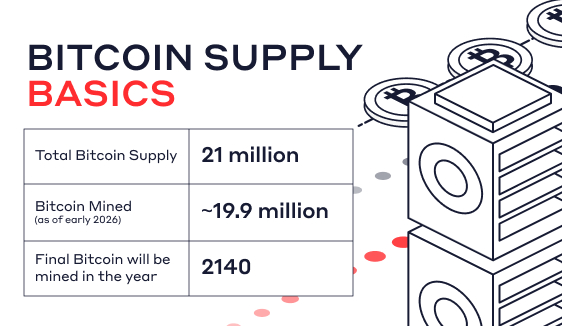
While most currencies can expand endlessly, Bitcoin follows a fixed rule: No more than 21 million will ever exist. This absolute scarcity, coded into Bitcoin's DNA from day one, sets it apart from most other forms of money.
Understanding Bitcoin supply is essential for anyone looking to grasp why this digital asset has captured the attention of individuals and institutions alike. In this guide, you’ll learn how Bitcoin's fixed supply works, why it matters, and what it means for the future of the world’s most recognized cryptocurrency.
Key Takeaways
- Bitcoin has an absolute maximum supply of 21 million coins, and this limit cannot be changed without broad network consensus.
- As of late 2025, approximately 19.95 million Bitcoin have been mined, about 95% of the total supply.
- An estimated 3 to 3.5 million Bitcoin are permanently lost. That’s 15% to 18% of the current supply.
- The halving mechanism cuts mining rewards in half approximately every four years, gradually slowing the rate at which new Bitcoin are issued.
- The most recent halving occurred in April 2024, reducing the block reward to 3.125 BTC.
- The last Bitcoin is projected to be mined by 2140, after which miners will rely solely on transaction fees for compensation.
- Bitcoin's predictable issuance schedule offers transparency that contrasts sharply with the monetary policies of many central banks today.
Why Bitcoin Supply Matters
Scarcity has long been associated with value. For example, gold became a store of wealth because it's difficult to find and expensive to extract. And real estate in desirable locations commands premium prices because no one can manufacture more land. Bitcoin applies this same principle by mathematically enforcing a fixed issuance schedule that can’t be changed without broad network consensus.
Compare this to traditional fiat currencies (e.g., U.S. dollars), where the money supply can be increased at a central bank’s discretion. When governments face budget shortfalls or economic crises, they can and frequently do print more money. Over time, expanding the money supply can dilute the purchasing power of every dollar, euro, or yen already in circulation.
Another way to think of it is like selling fruit at a farmer’s market. Traditional fiat currencies are like a stand that sells apples. They grow in abundance, and the seller replenishes their supply weekend after weekend.
A stand selling a rare fruit with a strictly limited harvest operates under very different conditions. Once the final harvest is complete, no additional supply enters the market, and availability becomes fixed.
Bitcoin’s supply follows the exotic fruit model. Its predictable issuance schedule and hard cap tie directly into basic economic discussions about scarcity and demand. This is one reason Bitcoin is often described as “digital gold.”
This programmed scarcity represents a core design principle outlined in Satoshi Nakamoto’s Bitcoin white paper, the 2008 document that first described how Bitcoin would work. Bitcoin’s open-source supply schedule allows anyone to verify in real time exactly how many coins exist and how many will be created in the future. There are no surprises, no emergency expansions, and no monetary policy decisions made in secret behind closed doors.
Bitcoin Total Supply Explained: The 21 Million Hard Cap
When Satoshi designed Bitcoin, one of the most consequential decisions was setting a fixed upper limit on how many coins could ever exist. Satoshi explained in a 2009 email that the decision to cap Bitcoin's supply at 21 million was an "educated guess," since it needed to be decided in advance without knowing how the future of Bitcoin would unfold.
In correspondence with early Bitcoin contributor Martti Malmi, Satoshi revealed the reasoning behind this choice:
"My choice for the number of coins and distribution schedule was an educated guess. It was a difficult choice, because once the network is going it's locked in and we're stuck with it. I wanted to pick something that would make prices similar to existing currencies, but without knowing the future, that's very hard."
The 21 million cap emerges mathematically from Bitcoin's issuance schedule. Starting with 50 Bitcoin per block and halving that reward every 210,000 blocks, the total supply converges to just under 21 million. New supply decreases until it eventually reaches zero.
Some worry that 21 million units aren't enough for a global currency, but Bitcoin's designer (or designers) anticipated this concern. Every Bitcoin can be divided into 100 million units called satoshis (sats). Bitcoin's divisibility ensures that, despite a seemingly low supply, it can serve as a medium of exchange.
This hard cap also distinguishes Bitcoin from other cryptocurrencies. Many digital assets have unlimited supplies or adjustable monetary policies controlled by development teams or foundations. Bitcoin's fixed limit, enforced by decentralized consensus rather than any central authority, makes it uniquely predictable.
Circulating Supply vs. Total Supply
While the total supply of Bitcoin is capped at 21 million, not all of those coins exist yet. The circulating supply refers to the number of Bitcoin that have actually been mined and are theoretically available for use. As of November 2025, 19.95 million BTC have been mined, which is about 95% of the fixed 21 million-coin supply limit.
This means that most of the Bitcoin that will ever exist are already in circulation. Only about 1.1 to 1.2 million BTC remain to be mined, roughly 5-6% of the total supply. The remaining coins will trickle into existence slowly until about 2140, when the final Bitcoin is projected to be mined.
The distinction between circulating and total supply matters for understanding Bitcoin's current scarcity. While 21 million represents the theoretical maximum, the actual number of accessible, tradable Bitcoin is significantly smaller.
Why Some Bitcoin Is "Illiquid" or Lost
Not all mined Bitcoin remains accessible for many reasons:
- An estimated 3 million to 3.5 million BTC (up to 18% of total supply) is permanently lost (due to forgotten passwords, discarded drives, deceased owners without shared keys, etc.), which further tightens market liquidity.
- Long-term holders are thought to hold about 74% of circulating BTC, reinforcing Bitcoin’s role as a store of value and shrinking the amount available for trading.
- The world’s largest asset manager, BlackRock, holds 776,000 BTC, or 6.7% of the current total supply, for their exchange-traded fund (ETF) products.
- As of September 2025, 5.6% of Bitcoin is also thought to be held by digital asset treasury companies (DATCOs), up from 3.5% in January, lowering liquidity even more.
Fidelity Digital Assets estimates that up to 8.3 million Bitcoin—roughly 42% of the circulating supply—could be classified as “illiquid” by 2032. As more institutions and long-term investors enter the space, this dynamic could intensify and further constrain the effective circulating supply.
How Is New Bitcoin Created?
New Bitcoin enters circulation through a process called mining. Unlike the mining of physical resources, Bitcoin mining involves specialized computers, which compete to solve complex mathematical puzzles.
Block rewards are the payments miners earn for adding new blocks to a blockchain and securing the network. When a miner completes Bitcoin’s SHA-256 cryptographic puzzle—the hashing process used to secure each block—and broadcasts a valid block to the network, they earn the reward attached to it.
At the time of writing, miners receive 3.125 Bitcoin for every block they add to the chain. This is their “reward,” and it’s how new Bitcoin are added to circulation.
The Bitcoin network adds a new block to the blockchain about every 10 minutes. This consistent timing is maintained through automatic difficulty adjustments that occur every 2,016 blocks. When more miners join the network, the puzzles become harder; when miners leave, they become easier. This mechanism ensures a predictable, steady flow of new Bitcoin, regardless of how much computing power is deployed.
A very simple way to think about this is: Imagine you work at a bank. Customers come in with receipts of purchases they’ve made. It’s your and the other tellers’ job to look at these receipts and verify that the purchases are accurate. Whichever teller is the quickest to verify the purchases and add them to the ledger receives a reward.
The Halving: Why Supply Tightens Every Four Years
One of Bitcoin's most important features is the halving.
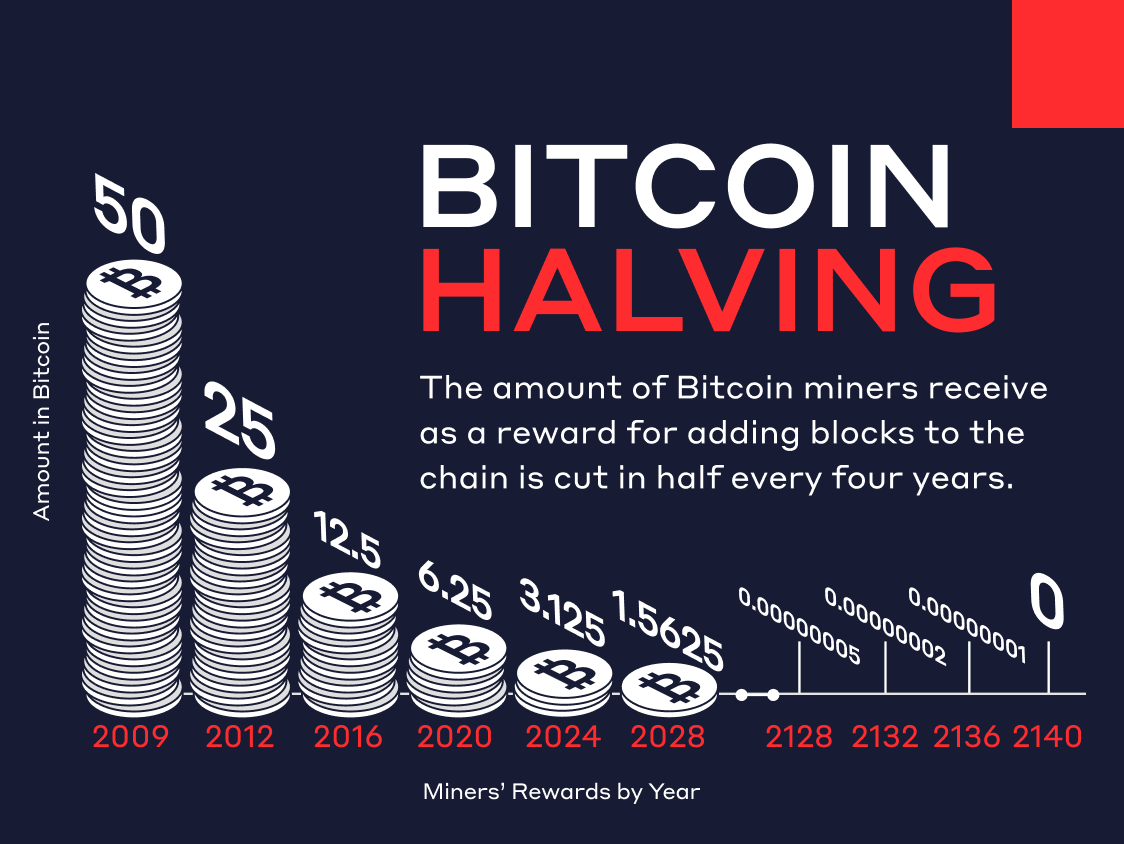
So, what is the halving? It’s a pre-programmed event that reduces the mining reward by approximately half every four years (or approximately every 210,000 blocks).
During a Bitcoin halving, the block reward is cut in half, so miners earn only half as many new coins for each block. When Bitcoin first launched, miners received 50 BTC per block, and the first halving in 2012 dropped that amount to 25 BTC, as shown below. It’s fallen every four years ever since.
While past performance doesn't guarantee future results, many analysts attribute these rallies to basic supply-and-demand dynamics.
The halving mechanism also reinforces Bitcoin's deflationary design. With each halving, the flow of new supply diminishes, making existing Bitcoin relatively scarcer. Many investors closely watch halving events, as they alter the supply dynamics of the asset. The next halving is expected on March 26, 2028, when the block reward will drop to 1.5625 BTC.
What Happens When All 21 Million Bitcoin Are Mined?
All 21 million Bitcoin will have been mined by about 2140. Once that point is reached, the network won’t produce any additional coins, and miners will only receive transaction fees as rewards.
This transition from block rewards to a fee-based model represents Bitcoin's long-term sustainability plan. As adoption grows and transaction volumes increase, fees may provide sufficient incentive for miners to continue securing the network. The Bitcoin community has over a century to adapt to how the fee market matures and develops.
Some skeptics question whether transaction fees alone can sustain network security, but Bitcoin's design potentially addresses this concern. If Bitcoin becomes more widely used and traded, transaction volumes could increase, generating more total fees, even if individual fees remain modest.
Can the 21 Million Cap Be Changed?
Technically, Bitcoin is open-source software, and any code can be modified. So yes, in theory, the cap can be changed. However, changing the 21 million cap would require broad agreement across the entire network. A Bitcoin improvement proposal (a formal proposal to change Bitcoin) or any comparable update must be written up, reviewed, and agreed on.
Most full nodes would then need to install the updated software. If a large number choose not to, they’d keep enforcing the existing rules and reject any block that tries to break the 21 million limit, which would lead to a fork in the network. That split would create a separate chain with a different rule set, just as the Bitcoin Cash fork occurred in 2017 when part of the community pushed for larger block sizes.
Beyond the technical hurdles, changing Bitcoin’s supply cap would face significant economic and social resistance. The fixed supply is a core part of Bitcoin’s design, and altering it would fundamentally change how the network operates and how participants relate to its monetary rules.
While the 21 million limit is not physically impossible to change, it is widely regarded as one of Bitcoin’s most stable and difficult-to-alter properties.
What Bitcoin's Finite Supply Means for the Future
Bitcoin's fixed 21 million supply creates a level of long-term scarcity that distinguishes it from most monetary systems in use today.
While gold is relatively scarce, new deposits continue to be discovered and mined. Central bank digital currencies, however they evolve, will remain subject to the same policy decisions that govern traditional fiat currencies, including how much new currency is issued and when. But the final supply of Bitcoin is already defined.
As the circulating supply tightens due to lost coins and long-term holding, the available Bitcoin for trade becomes more constrained. This dynamic may influence how individuals and institutions think about storing value.
Bitcoin’s supply is transparent and predictable compared to many other assets, as its issuance schedule is public and predictable. This consistency allows individuals and institutions to evaluate Bitcoin’s monetary properties based on clear, observable rules.
America’s expanding presence in Bitcoin mining and digital asset infrastructure is giving it a stronger foothold in the digital economy. As more countries start to understand what makes Bitcoin different, the ones with solid mining operations and clear rules around it are positioning themselves to engage more actively in this space.
How Can America Grow Its Bitcoin Supply?
Bitcoin's fixed supply is at the foundation of its network. The 21 million hard cap creates programmed scarcity, halvings systematically reduce new issuance, and millions of lost coins further tighten the effective supply. Together, these dynamics distinguish Bitcoin’s monetary structure in the context of expanding fiat money supplies.
Understanding Bitcoin’s supply provides an important framework for investors and other market participants studying its role within modern financial systems. Through efficient mining operations and disciplined treasury practices, ABTC works to help anchor key parts of the Bitcoin network within a transparent, U.S.-based infrastructure environment.
American Bitcoin Corp (Nasdaq: ABTC) is focused on strengthening America’s role within that system. By building efficient mining operations and supporting U.S.-based digital asset infrastructure, ABTC works to help anchor key components of the Bitcoin network.
Learn more about how American Bitcoin is strengthening Bitcoin mining capacity and supporting America’s role in Bitcoin adoption.
Bitcoin Supply FAQs
1. Who decided Bitcoin's 21 million supply limit, and can it ever be changed?
Bitcoin’s creator, Satoshi Nakamoto, established the 21 million cap as an "educated guess" designed to balance scarcity with usability. Changing this limit would require wide consensus among developers, miners, node operators, and users—a scenario considered by many to be highly unlikely.
2. How many Bitcoin have been mined so far, and how many are left?
As of late 2025, approximately 19.95 million Bitcoin have been mined, or about 95% of the total supply. Roughly 1.1 million BTC remain to be mined over the next 115 years.
3. What is Bitcoin halving, and how does it affect new supply?
The halving is a pre-programmed event occurring approximately every four years that cuts the mining reward in half. The most recent halving in April 2024 reduced the reward from 6.25 to 3.125 BTC per block. This mechanism gradually slows the creation of new Bitcoin, reinforcing its scarcity over time.
4. When will the last Bitcoin be mined, and what happens after that?
The final Bitcoin is projected to be mined around the year 2140. After that, miners will rely entirely on transaction fees for revenue rather than newly created coins. The network will continue operating normally with this fee-based incentive model.
5. What impact do lost or inaccessible Bitcoins have on effective supply?
An estimated 3 to 3.5 million Bitcoin are permanently lost due to forgotten passwords, discarded hardware, or the death of owners. This effectively reduces the circulating supply, making the remaining accessible Bitcoin more scarce. Lost coins cannot be recovered and remain locked on the blockchain forever.
6. Why do investors care about Bitcoin's predictable issuance schedule?
Bitcoin’s transparent supply schedule allows anyone to verify how many coins exist today and how many will be issued over time. This predictability differs from fiat currency systems, where supply levels are influenced by ongoing monetary policy decisions. As a result, Bitcoin’s issuance model is frequently referenced in discussions about monetary design, transparency, and long-term supply frameworks.
7. Why do individuals and corporate treasuries often examine Bitcoin’s hard-capped supply?
Bitcoin’s fixed supply means the total number of coins that can ever exist is known in advance and cannot be expanded through discretionary policy decisions. This design differs from fiat currency systems, where supply levels can change over time. As a result, Bitcoin’s hard cap is frequently discussed by individuals and corporate treasuries when evaluating different monetary frameworks and supply models.
Sources
- "The History of Bitcoin Halving." Kraken. https://www.kraken.com/learn/Bitcoin-halving-history
- "What Happens After All Bitcoin Is Mined?" River Learn. https://river.com/learn/what-will-happen-after-all-Bitcoin-mined/
- "Bitcoin Halving Dates & Countdown to 2028." Crypto.com. https://crypto.com/en/Bitcoin/halving-countdown
- "Understanding Block Rewards." Built In. https://builtin.com/articles/block-reward
- “Bitcoin future market dynamics and demand.” Binance. https://www.binance.com/en/square/post/16274975403017
- “Understanding How Does Bitcoin Work.” Token Metrics. https://www.tokenmetrics.com/blog/understanding-how-does-bitcoin-work
- “How many bitcoin are there? Bitcoin supply explained.” Kraken. https://www.kraken.com/learn/how-many-bitcoin-are-there-bitcoin-supply-explained
- “Can We Change Bitcoin’s Cap of 21 Million?” Blockchain Council. https://www.blockchain-council.org/cryptocurrency/bitcoins-cap-of-21-million/
- “Wall Street continues to sell off—how much further will bitcoin fall?” Bitget. https://www.bitget.com/news/detail/12560605048162
- “Major milestone in the crypto asset market: The Bitcoin halving explained.” EY. https://www.ey.com/en_ch/insights/blockchain/the-bitcoin-halving-explained