.jpg)
Bitcoin vs. Gold: A Guide for New Investors
Compare Bitcoin and gold as investments. Explore volatility, returns, storage, inflation protection, and which asset fits your portfolio in 2025.
Bitcoin vs. Gold: A Guide for New Investors
Bitcoin picked up the nickname “digital gold” long before most Americans ever owned it. The comparison has stuck because, like gold, Bitcoin is scarce and used by many people as a way to store value outside the dollar system.
But how does Bitcoin actually compare to gold, and why do some investors describe it as a kind of “digital alternative” to the precious metal that’s been coveted for millennia?
This guide compares Bitcoin vs. gold and explains why many now view Bitcoin as a modern counterpart to gold.
Key Takeaways
- Bitcoin is an asset that’s used for commerce and investments, similar to gold and other precious metals.
- Bitcoin and gold are both in limited supply, which is one reason many investors treat them as long-term stores of value.
- Because digital (Bitcoin) and physical (gold) assets work differently, it helps to understand the tradeoffs of each and how they might fit into your broader financial plan.
Gold’s Legacy: Thousands of Years of Monetary Trust
Gold has anchored money and wealth for thousands of years. Long before digital assets, societies used it to measure value and settle trade. Any Bitcoin vs. gold comparison has to start with that track record.
As one of the world’s oldest and most sought-after natural resources, gold has shaped trade from early civilizations to modern economies. Over time, it became both a store of wealth and, in many places, a form of money.
Gold’s scarcity and durability made it the foundation of monetary systems for much of recorded history. Ancient Egypt, for example, was already mining and working gold into the form we know today by about 3600 BCE.
Governments began formalizing the value of gold for trade over time. Notably, the United Kingdom adopted the gold standard, a monetary system that tied the value of its currency to a fixed amount of gold, in 1717. By the late 19th century, many major economies had followed suit. While countries, including the United States, no longer back each unit of currency with metal in a vault, gold remains a significant holding for central banks.
Today, gold’s value is determined by public markets. It’s an actively traded commodity on exchanges such as the New York Mercantile Exchange (NYMEX), the London Metal Exchange (LME), the Dubai Gold & Commodities Exchange (DGCX), and the Tokyo Commodity Exchange (TOCOM).
Beyond investing, gold is also widely used in jewelry, ornate decorations, electronics, and medical devices, adding to its overall demand. In 2025, gold’s value hit record highs above $4,000 per ounce.
The Rise of Bitcoin: A Digital Alternative to Precious Metals
Gold has earned its place as a long-lasting store of value, but it is no longer the only asset people turn to when they want strength and stability. Just as silver, copper, and platinum offer alternatives within the world of metals, Bitcoin has emerged as a modern option in the digital world.
For centuries, societies have assigned value to dollars, euros, and other government-issued currencies. We save them, move them around online, and store them in banks because we collectively agree they hold value. Bitcoin follows a similar idea, but it operates in a completely digital environment.
Bitcoin was first described in a 2008 white paper titled “Bitcoin: A Peer-to-Peer Electronic Cash System,” by the pseudonymous creator Satoshi Nakamoto. It outlined a system for digital money that does not rely on a central authority. Instead, transactions are verified by thousands of computers and recorded on a public, tamper-resistant ledger known as the blockchain. That core design remains largely unchanged today.
Here are some unique features of Bitcoin that give it a distinct role alongside precious metals:
- Limited supply: Bitcoin is a limited, finite resource. Just as there’s a limited supply of gold buried in the earth, there’s a limited supply of Bitcoin available for mining. The maximum supply of Bitcoin is 21 million coins. Once that’s reached, no new Bitcoin can be created.
- Broad appeal and demand: Reports estimate that more than 500 million people worldwide own Bitcoin, or nearly 7% of the global population. Adoption continues to expand, particularly in regions where national currencies face high inflation or limited banking infrastructure, like El Salvador, India, Pakistan, Brazil, Vietnam, Ukraine, and Nigeria.
- Used for transactions: The first documented purchase using Bitcoin was for pizza in 2010. At least 15,000 businesses now accept Bitcoin directly for purchases. Many large companies also work with partners to accept Bitcoin and convert it to dollars immediately. Consumers can also use crypto-enabled debit cards that let them spend from a Bitcoin balance anywhere traditional cards are accepted.
- Used as a store of value: Bitcoin is the largest digital asset by market value, and many individuals and institutions hold it as a way to store value that can be moved and converted quickly across borders. Some view it as a hedge against currency debasement or persistent inflation, though its price has also shown significant volatility over time.
Bitcoin is portable, verifiable, and independent of central control. As more people understand how Bitcoin works, its global adoption continues to grow, including as a hedge against inflation.
Bitcoin vs. Gold: Core Differences Explained
Below, we’ll break down the key differences between gold and Bitcoin.
Storage and Security
Gold is a physical, tangible asset. It requires physical storage, like a vault, to keep it secure from theft or damage.
Bitcoin, on the other hand, exists entirely in digital form. You can’t touch it, but you still have to protect it from theft or loss.
Where you can use a physical key to unlock a gold vault, you use cryptographic keys to unlock a Bitcoin wallet and send it to another wallet address.
Scarcity and Supply
While gold has scarcity and a limited supply, the amount of gold in circulation slowly increases as it’s mined. There’s little risk of the supply of gold dramatically increasing overnight, but we’ll likely keep extracting more and more of it indefinitely.
The supply of Bitcoin also grows through mining, though it's a digital form rather than the kind that uses picks and shovels or large excavators. Once the supply of Bitcoin reaches 21 million, no more can ever be mined. That fixed cap is one reason many people describe Bitcoin as “digitally scarce.”
Divisibility and Portability
If you have a gold coin, it’s not easy to cut out a sliver of it to make a purchase at the checkout stand. Gold is heavy, can be expensive to transport, and is difficult to divide into easily measurable sub-units without specialized equipment. Gold is used in commerce and trade, but doing so is difficult and costly.
Bitcoin, on the other hand, can move across international borders with just a few clicks on your computer or taps on your smartphone. Every Bitcoin is divided into 100 million units called satoshis, or SATs. You can send 100 Bitcoin or a millionth of a Bitcoin with the same ease.
Verification and Transparency
People used to bite into gold coins to see if they were real. These days, gold purity is typically verified by trusted third parties using special measurement tools, but fake and low-quality gold can still be passed off as something more valuable. And because gold is a physical asset, it can be stolen if someone gets access to it.
Bitcoin works differently. Every transaction is recorded on the public blockchain, and software can verify that a given coin hasn’t been double-spent. That design makes it very difficult to create fake Bitcoin that the network will accept.
All Bitcoin transactions are visible on the blockchain and linked to public wallet addresses. That means activity is public, but not directly tied to your name by default. Control over funds is tied to private keys: If those keys are exposed or lost, coins can be taken or may become inaccessible. Strong key management reduces the risk of theft, but it does not eliminate it.
Volatility and Maturity
Two of gold’s biggest advantages are its consistency and longevity. Gold markets have a centuries-old history and exhibit relatively low volatility. Prices rise and fall every day, but large swings in the value of an ounce of gold are less common.
Bitcoin markets are much younger, and with rapid adoption and many active speculative traders, Bitcoin's price is much more volatile. Prices can swing dramatically in short time frames. The price of Bitcoin has moved 20% or more in a day many times.
Bitcoin vs. Gold Market Cap and Global Scale
Estimating the total value of all Bitcoin is straightforward. Using the blockchain, we can see the number of BTC in circulation, multiply by the market price, and get the total market value, or market capitalization (market cap). For much of 2025, Bitcoin's market cap hovered around $2 trillion.
Sizing the total market value of gold is much harder. For example, we don’t know exactly how much gold jewelry every person owns, or how much is still underground. However, it’s believed that the market capitalization of gold is roughly $22 trillion.
If we discover and mine a lot more gold, the extra supply could put pressure on the price of an ounce. Bitcoin flips that script. We know there’s no hidden stash waiting to be discovered, as its issuance schedule is fixed and public. And, as people occasionally lose access to their wallets, the circulating supply of Bitcoin may shrink over time, even as gold's supply keeps growing.
Performance Comparison: Bitcoin vs. Gold Chart Over Time
Gold has a long record of stability. It’s often used as an alternative to national currencies during times of high inflation or economic uncertainty.
If you look at the percentage change in Bitcoin and gold’s value over the last 10 years, Bitcoin has skyrocketed, while gold’s gains have been more modest.
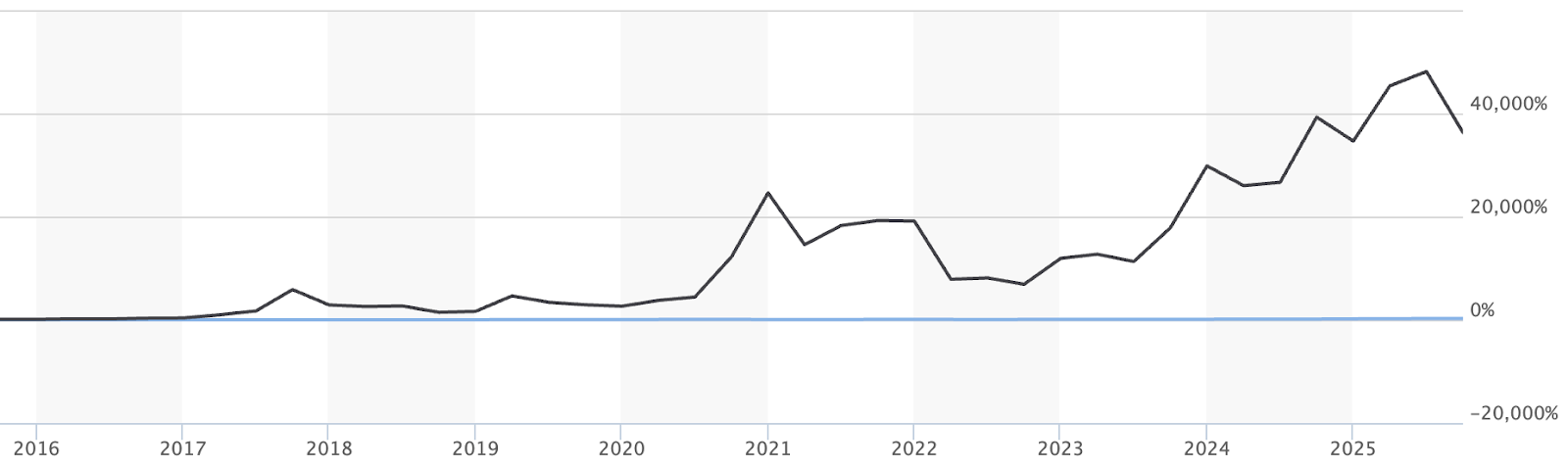
Chart via Marketwatch. Bitcoin in black and Gold in blue. Ten-year view.
If you bought Bitcoin in 2015, its price would show a gain of more than 20,000% a decade later. Over the same period, gold’s price increased by about 300%. The volatility becomes more apparent when you compare the two over the last five years. You can see the bigger ups and downs of Bitcoin, but the cumulative change over that span has still been higher than gold’s.
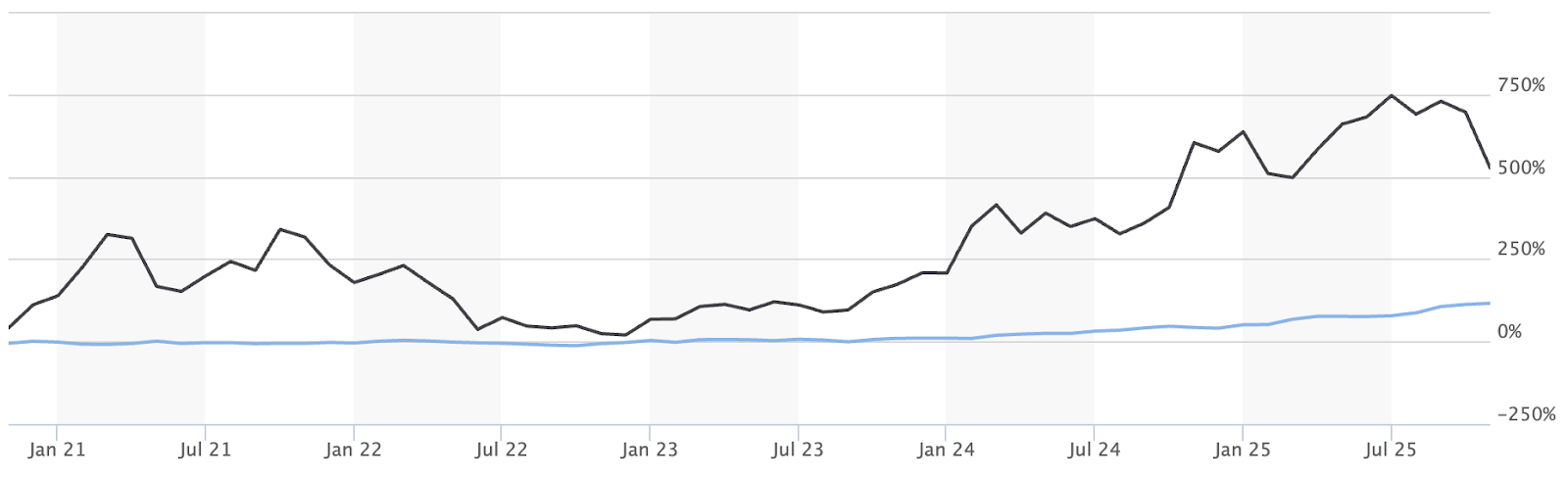
Chart via Marketwatch. Bitcoin in black and Gold in blue. Five-year view.
As it’s matured, some observers believe Bitcoin’s day-to-day volatility has moderated compared with its earliest years, though it remains a highly volatile asset. Over the last five years, Bitcoin’s price has climbed more than 500%, compared to around 120% for gold.
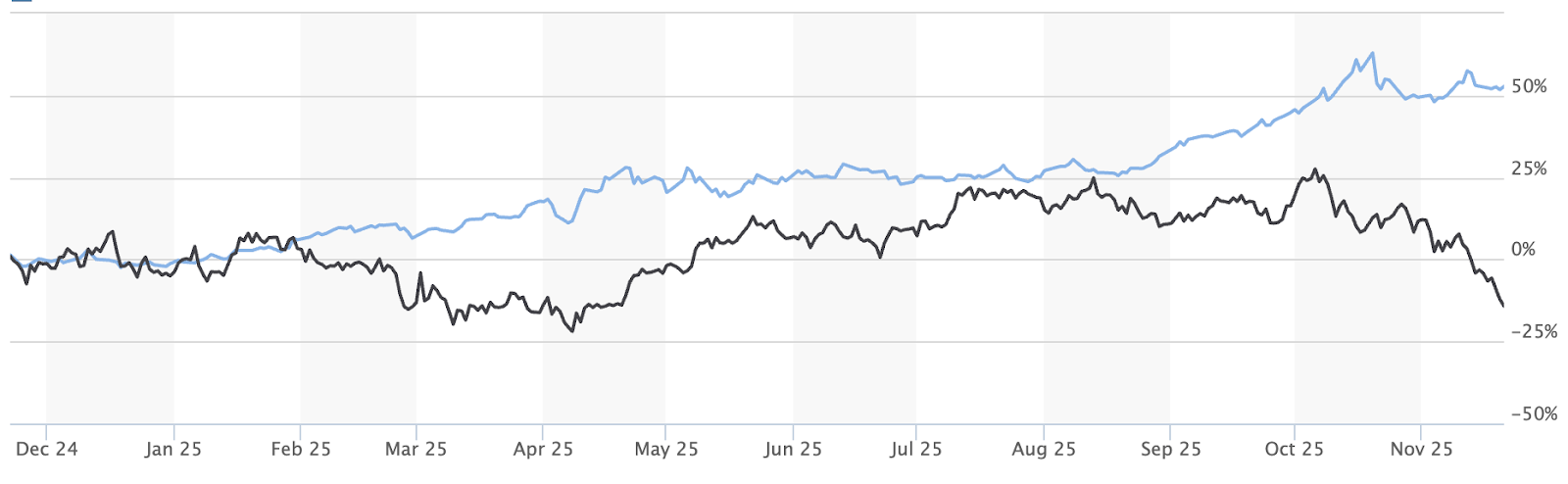
Chart via Marketwatch. Bitcoin in black and Gold in blue. One-year view.
Over the past year, the picture looks very different: Gold has climbed by roughly 50%, while Bitcoin has trended downward by about 20 to 25%.
Long-term Bitcoin “HODLers”—investors who hold through multiple market cycles rather than trading in and out—have seen swings like this before and often view them as part of Bitcoin’s normal price behavior.
Risks and Considerations
Both gold and Bitcoin carry real risks for investors to weigh. Each introduces its own kind of uncertainty, which shows up in very different ways.
For gold, the primary concerns are physical storage and logistics. If you hold bullion or coins directly, you have to think about secure storage, insurance, transportation, and verification. There is also some liquidity risk if you ever need to sell quickly and must accept a discount to sell through a local dealer.
Gold-backed exchange-traded funds (ETFs) and vaulting solutions can reduce some logistical burdens. Still, you’re relying on a custodian or fund manager and typically paying ongoing fees for asset management.
Bitcoin’s risk profile is more focused on technology and regulation. Self-custody requires strong digital security practices. Private keys that are lost, stolen, or exposed cannot be recovered, and cyberattacks and scams are an ongoing concern. Even when using reputable custodians, you are relying on their security controls.
Bitcoin is also subject to an evolving regulatory environment, which can affect everything from how it is taxed to how institutions are allowed to hold it.
Both assets are volatile, although in different ways. Bitcoin has historically shown sharp price swings over short periods, while gold tends to move more slowly but can still experience meaningful downturns. Liquidity is generally high for both, but it can become more limited during periods of economic strain or in certain local markets.
Because the risks are so different, anyone considering gold or Bitcoin may want to study them in detail and think about how they line up with their own risk tolerance and broader strategy.
What Does the Future Hold for Bitcoin and Gold?
Nobody knows precisely what will happen in the future for Bitcoin, gold, or any other investment. What we can do is look at their histories so far, how they’re designed, and how people use them today.
Many observers expect gold and Bitcoin to play complementary roles. They share many features, such as scarcity, active trading markets, and their ability to be used for purchases or investments. They both act as stores of value: one a traditional, physical asset and the other a digital one.
Technological and generational shifts, as well as personal preferences, could push one higher than the other at different points in time. Perceived risks and economic factors may cause volatility and extended periods of gains or losses.
But one thing is certain. As of today, many think of Bitcoin as “digital gold,” and both assets have promising futures.
From Gold Bars to Digital Blocks
Gold bars are one of the most familiar ways to store a lot of value in a small space. They’re a trusted, constant measure of value, which is why people and institutions lock them away in vaults and safes.
Bitcoin lives in a very different format. Instead of bars, it’s recorded in “blocks” of transactions on a blockchain—shared ledgers that are updated and verified by computers around the world. Those blocks sit in code (not a vault).
As digital systems become a larger part of global finance, our ideas about what can hold value are expanding. Many people choose to hold a mix of traditional assets like gold alongside newer digital assets, depending on their goals and comfort level.
Both now sit side by side in the way many people think about where they store long-term value.
Bitcoin vs. Gold FAQs
Can Bitcoin replace gold as a store of value?
Bitcoin isn’t likely to completely replace gold as a store of value. More often, people talk about Bitcoin and gold as complementary options for investors looking to hold a more diversified portfolio. Looking at the latest Bitcoin vs. gold market caps in late 2025, the total value of gold sat at about 11 times that of Bitcoin.
Why is Bitcoin called digital gold?
Bitcoin is called digital gold because it’s a scarce asset with exceptional value. Gold and Bitcoin share many characteristics, despite one being a physical asset and the other being digital.
Which is more volatile: Bitcoin or gold?
Bitcoin is generally much more volatile than gold. As a newer asset with more speculative trading, Bitcoin is known to experience big swings, sometimes more than 20% in a day. Gold, on the other hand, tends to rise and fall in value more gradually.
What are the main differences between Bitcoin and gold?
Bitcoin and gold differ in many ways, including:
- Gold is physical and requires vaults, insurance, and verified handling, while Bitcoin is fully digital and protected with cryptographic keys.
- Gold’s supply grows slowly as more is mined, but Bitcoin has a fixed cap of 21 million.
- Gold is heavy and hard to divide, while Bitcoin is easily portable and divisible into 100 million satoshis.
- Gold markets are stable and long-established, whereas Bitcoin’s market is relatively young and more volatile.
- Verifying gold’s purity and realness requires testing, while Bitcoin is openly verifiable on the public blockchain.
Can I hold both Bitcoin and gold in my portfolio?
Investors can certainly hold both Bitcoin and gold in their portfolios. Many investors invest directly in both assets, or indirectly through mining companies like Newmont Mining for physical gold or American Bitcoin for digital gold. Both are available through investment funds, exchange-traded funds (ETFs), and other asset classes.
How do Bitcoin and gold perform during economic uncertainty?
During times of economic uncertainty, trusted stores of value tend to rise in price. For those holding United States dollars, traditional hedges have included gold, silver, and foreign currencies like the Swiss franc. In modern times, digital currencies like Bitcoin and Ether (the primary coin of the Ethereum blockchain) act as a digital hedge against economic downturns.
Is gold more stable than Bitcoin?
Gold is generally more stable than Bitcoin. If you look at price charts over varying periods of time, you’ll notice that Bitcoin is more prone to significant price swings over short periods of time, while gold tends to trend slowly up or down based on economic and market conditions.
How do Bitcoin and gold differ in terms of returns?
Over shorter periods, Bitcoin has seen dramatic bull runs and deep drawdowns, while gold’s gains and losses tend to be more gradual. Gold often behaves like a defensive asset, preserving value during stress, whereas Bitcoin can behave more like a high-growth, high-risk technology asset. Investors who prioritize stability often lean toward gold, while return-seekers may tilt more toward Bitcoin.
Sources
- A Brief History of Gold. The Royal Mint. https://www.royalmint.com/invest/discover/gold-news/a-brief-history-of-gold/
- Where Is Gold Traded? A Guide to Major Gold Exchanges Around the World. AG Metals. https://agmetals.com/a-guide-to-major-gold-exchanges-around-the-world/
- Gold Price Today | Gold Spot Price Charts. APMEX. https://www.apmex.com/gold-price
- Science & Technology Spotlight: Blockchain & Distributed Ledger Technologies. U.S. Government Accountability Office (GAO). https://www.gao.gov/assets/gao-19-704sp.pdf
- The Bitcoin Whitepaper. Bitcoin.com.au. https://Bitcoin.com.au/education/the-Bitcoin-whitepaper/
- Rep. Warren Davidson Introduces the Bitcoin For America Act. Congressman Warren Davidson. https://davidson.house.gov/2025/11/rep-warren-davidson-introduces-the-Bitcoin-for-america-act
- How Many People Own, Hold & Use Bitcoins? Bitbo. https://bitbo.io/how-many-users/
- Cryptocurrency Ownership Data. Triple-A. https://www.triple-a.io/cryptocurrency-ownership-data
- The Chainalysis 2025 Global Crypto Adoption Index. Chainalysis. https://www.chainalysis.com/blog/2025-global-crypto-adoption-index/
- First Commercial Bitcoin Transaction. Guinness World Records. https://www.guinnessworldrecords.com/world-records/696240-first-commercial-Bitcoin-transaction
- Who Accepts Bitcoin Payments in 2025? Crypto.com. https://crypto.com/us/Bitcoin/who-accepts-Bitcoin-payments-in-2024
- How Does Bitcoin Have Value If It’s Backed by Nothing? CoinLedger. https://coinledger.io/learn/what-is-Bitcoin-backed-by
- Bitcoin: An Inflation Hedge but Not a Safe Haven. ScienceDirect. https://www.sciencedirect.com/science/article/pii/S1544612321003810
- Bitcoin for Individuals. Bitcoin.org. https://Bitcoin.org/en/Bitcoin-for-individuals
- What Happens to Bitcoin After All 21 Million Are Mined? Investopedia. https://www.investopedia.com/tech/what-happens-Bitcoin-after-21-million-mined/
- Understanding Bitcoin Satoshis: A Comprehensive Guide. Kraken. https://www.kraken.com/learn/what-are-Bitcoin-satoshis-sats
- Why Do Pirates and Champions Bite Gold Coins and Medals? Persée. https://www.persee.fr/doc/numi_0484-8942_2018_num_6_175_3433
- Gold Scams, and How to Avoid Them. J. Rotbart & Co. https://jrotbart.com/gold-scams-and-how-to-avoid-them/
- Melt Values and Melt Value Prices. APMEX. https://learn.apmex.com/investing-guide/melt-values-and-melt-value-prices/
- How Does Bitcoin Work? Bitcoin.org. https://Bitcoin.org/en/how-it-works
- Bitcoin Historical Data. Investing.com. https://www.investing.com/crypto/Bitcoin/historical-data
- Bitcoin Price: BTC Live Price Chart, Market Cap & News Today. CoinGecko. https://www.coingecko.com/en/coins/Bitcoin
- Prediction: Bitcoin Could Be Worth $20 Trillion in 5 Years. Nasdaq. https://www.nasdaq.com/articles/prediction-Bitcoin-could-be-worth-20-trillion-5-years
- 20% of All BTC Is Lost, Unrecoverable, Study Shows. Investopedia. https://www.investopedia.com/news/20-all-btc-lost-unrecoverable-study-shows/
- Gold Continuous Contract (GC00) Chart. MarketWatch. https://www.marketwatch.com/investing/future/gc00/charts?mod=mw_quote_advanced
- What Risks Are Involved in Gold Investment? Expert Answers. Physical Gold. https://www.physicalgold.com/insights/what-risks-are-involved-in-gold-investment/
- Consumer Advisory: Virtual Currencies. Consumer Financial Protection Bureau (CFPB). https://files.consumerfinance.gov/f/201408_cfpb_consumer-advisory_virtual-currencies.pdf