
What is a Bitcoin Accumulator: Strategy, Purpose & Insights
Learn what Bitcoin accumulation means for corporate treasuries. Understand how companies strategically acquire and hold BTC as a long-term asset.
What Is Bitcoin Accumulation & How Does It Work?
Bitcoin accumulation is a term for systematically stockpiling Bitcoin on a balance sheet.
Many people are familiar with dollar-cost averaging in the stock market, a strategy that involves buying small amounts on a regular schedule. The same is possible with Bitcoin, but accumulation can also happen through other ways unique to the Bitcoin ecosystem.
Today, more than 45 million wallets hold a balance of $1 or more in Bitcoin, reflecting the growing global participation in the network.
People and organizations accumulate Bitcoin in a variety of ways, including purchasing it through a wallet or exchange, earning it through mining, or holding it in an account where it accumulates interest.
Here’s a closer look at how Bitcoin accumulation works, why some companies and individuals choose to build Bitcoin treasuries, and the different approaches people use to grow their Bitcoin holdings over time.
Key Takeaways
- Businesses and individuals accumulate Bitcoin for a range of reasons, including operational use, payments, and long-term holding.
- Bitcoin holdings can grow in different ways. For example, people and organizations can acquire it through the market or earn it through mining.
- Some publicly traded companies hold Bitcoin on their balance sheets, which gives investors exposure to Bitcoin without purchasing it directly.
What Is Bitcoin Accumulation?
A Bitcoin accumulator is a person or business that works to build their Bitcoin balance over time. Instead of emphasizing trading in and out of the market, accumulators focus on long-term ownership.
In practice, Bitcoin accumulation takes place through mining, treasury management, or periodic purchases.
Here’s a brief look at how those activities work:
- Bitcoin mining: Miners support the Bitcoin network by verifying and recording transactions. In return, they can earn newly created Bitcoin. Because mining requires specialized equipment and significant energy, it’s most often done by companies with the right infrastructure.
- Treasury management: A company chooses to hold Bitcoin as part of its long-term reserves, similar to how a business might hold cash or other assets. It usually involves working with secure custodians and setting clear rules for how the Bitcoin is stored, tracked, and managed.
- Periodic purchases: Some individuals and organizations acquire Bitcoin gradually over time, adding to their holdings at regular intervals—a practice similar to dollar cost-averaging.
Unlike short-term trading and speculation, accumulation is typically associated with long-term participation in the Bitcoin ecosystem. In traditional stock market investing, it’s called buy-and-hold. In the cryptocurrency markets, it’s often called HODLing, or holding on for dear life.
Accumulation also plays a role in shaping the market, helping anchor Bitcoin's value to a level that reflects the market’s overall belief in its intrinsic value rather than the whims of active and algorithmic traders. It reduces the currency's circulating supply, similar to when savers deposit dollars into savings accounts or investors buy Treasury bonds.
Individuals and institutions regularly accumulate Bitcoin. While they’re likely operating at different scales, they share the same interest in the network’s long-term potential.
How Do Bitcoin Accumulators Work?
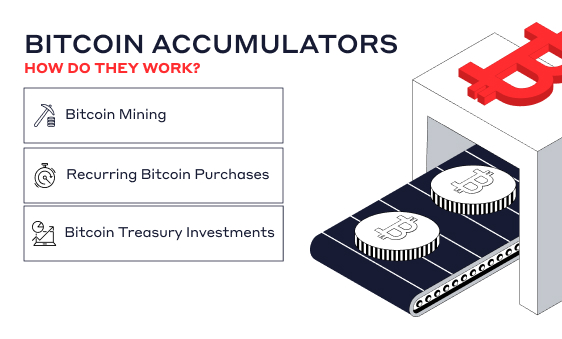
Here’s a more detailed look at how Bitcoin accumulators work.
Bitcoin Mining Operations
Mining uses powerful computers to help process and secure Bitcoin transactions. Miners compete to approve each new “block” on the Bitcoin blockchain, and the winner earns newly created Bitcoin plus transaction fees.
The amount of new Bitcoin awarded decreases over time until all 21 million coins are mined. After that, miners will only earn transaction fees, sometimes called “gas” in the cryptocurrency industry.
Recurring Bitcoin Purchases
Bitcoin trades globally on a 24/7 market, and many participants choose to add to their holdings gradually over time. People or organizations can store their holdings in an exchange account or in an offline, cold wallet.
Because Bitcoin’s price can swing up or down quickly, some participants acquire small amounts over time to reduce the impact of short-term volatility.
Bitcoin Treasury Investments
Companies like American Bitcoin (ABTC) hold and use Bitcoin as part of their operating and investment strategy. Large-scale accumulators generally follow structured accumulation models to manage volatility and maintain liquidity.
In some cases, large Bitcoin holders may invest their Bitcoin using exchanges, decentralized finance (DeFi), or other methods to earn interest on their holdings. As with any third-party service, users must understand that transferring Bitcoin to another entity involves the risk of forfeiting control.
The Role of Bitcoin Accumulation in Market Dynamics
Bitcoin is subject to the same economic forces of supply and demand as any other investment or asset class. An increase in demand increases the price of an asset, as does a decrease in supply. Bitcoin accumulators help support Bitcoin's price by consistently holding Bitcoin rather than trading in and out, which reduces short-term market pressure.
Analysts often describe long-term holders as “strong hands.” These are individuals, companies, and funds that plan to hold Bitcoin through multiple market cycles rather than react to every price swing. By holding their positions rather than selling into every pullback, strong hands can reduce selling pressure and help stabilize the network during periods of volatility. Their conviction is reflected directly on the blockchain.
According to an analysis by CoinLedger:
- Nearly three-fourths (74%) of Bitcoin is owned by long-term investors, while a relatively small number of high-volume traders make up the vast majority of market activity.
- Eighty-three wallets control over 11% of the total Bitcoin supply, and those super HODLers have outsized control over market prices.
- About 20% of the Bitcoin supply is suspected to be lost forever, further reducing active circulation.
Public companies, governments, and investment funds (ETFs, mutual funds, hedge funds) have played a growing role in the cryptocurrency ecosystem. More than 100 large institutional investors publicly report Bitcoin treasury holdings, including more than 30 governments.
Several publicly traded companies operate in the Bitcoin space as well. American Bitcoin (ABTC), for example, accumulates Bitcoin through its mining operations and maintains Bitcoin as part of its broader corporate strategy.
As of late 2025, American Bitcoin held more than 4,000 BTC.
As it has matured, Bitcoin has become increasingly integrated into business operations.
Why Companies Choose to Accumulate Bitcoin
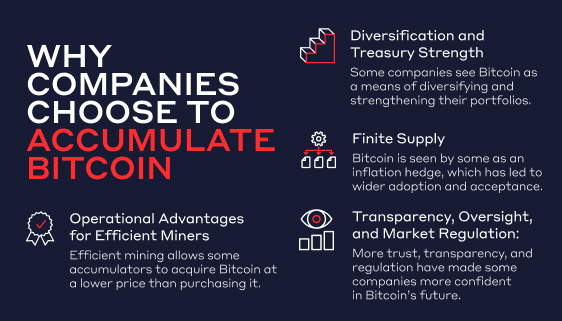
Companies choose to hold Bitcoin in their treasuries for several reasons. Each organization approaches Bitcoin differently, depending on its business model and long-term objectives.
Diversification and Treasury Strength
Many organizations aim to diversify their holdings across multiple forms of currency and assets. In addition to traditional fiat currencies, some companies include Bitcoin as part of a broader treasury approach.
As Bitcoin becomes more widely adopted, some businesses view it as an additional option within their treasury mix. Similar to how investors diversify across different asset types, companies may incorporate Bitcoin alongside traditional currencies to broaden their treasury profile and engage with emerging digital asset markets.
Finite Supply and Growing Institutional Acceptance
Bitcoin’s fixed supply of 21 million coins and transparent issuance schedule make it distinct from traditional currencies. These characteristics, together with increased institutional participation, have led some companies and funds to explore Bitcoin as part of a long-term treasury or technology strategy.
A growing number of institutions, funds, and public companies recognize the value of the finite currency. Where governments can effectively print money, which can cause inflation and currency devaluation, that’s not possible with Bitcoin.
Operational Advantages for Efficient Miners
Companies with access to low-cost energy and the latest mining technology can sometimes mine Bitcoin at an all-in cost below the current market price. That allows companies to accumulate Bitcoin at a discount compared to buying it on an exchange.
Over time, large-scale miners with the most efficient operations are well-positioned to mine Bitcoin, sell a portion of their proceeds to support operations, and retain the rest in a growing BTC treasury.
Transparency, Oversight, and Market Regulation
Bitcoin strategies are transparent by default, as anyone can view every transaction on the public Bitcoin blockchain. As the industry matures, it’s also becoming subject to government regulation and corporate governance norms. This increasing oversight is a key factor in opening Bitcoin up for use by mutual funds, ETFs, and other publicly traded securities.
Bitcoin Accumulators vs. Bitcoin Traders
Bitcoin accumulators and Bitcoin traders participate in the same market, but they approach it with very different mindsets.
Accumulators focus on building a long-term position over months or years. Traders focus on short-term price moves and look for opportunities to buy low and sell high over much shorter time frames.
For accumulators, the primary goal is to steadily increase the amount of Bitcoin they hold rather than time every price swing. They often use structured strategies such as recurring purchases, mining, or treasury allocation policies. The emphasis is on consistency, risk management, and alignment with long-term goals.
Trading, by contrast, is built around active decision making and market timing. Traders rely on technical indicators, market news, and liquidity conditions to make frequent buy and sell decisions. Some succeed, but trading does introduce higher behavioral and execution risks.
On the corporate side, accumulation is rarely a casual decision. Public companies and funds that hold Bitcoin must consider operational costs, treasury policies, liquidity needs, risk controls, and formal disclosure requirements. Their capital allocation plans are usually part of a broader framework approved by leadership and reviewed by investors.
In that sense, Bitcoin accumulation is often a measured, strategic approach to participating in the Bitcoin economy.
Bitcoin Investors and the Accumulation Mindset
Bitcoin investors with an accumulation mindset are playing the long game. They focus less on short-term price swings and more on building a durable position that fits within their broader views on Bitcoin and digital assets.
- Education: Accumulators often start by learning how Bitcoin works, why its supply is limited, and how it fits into the larger digital asset landscape. They seek to understand the technology, the risks, and the potential benefits before making long-term decisions.
- Levelheadedness: This mindset accepts volatility as part of the Bitcoin experience. Accumulators plan to hold through multiple market cycles and may add to their holdings gradually over time rather than reacting to every market movement.
- Institutional infrastructure: Some long-term accumulators choose structured, regulated vehicles like public companies, funds, or ETFs that provide Bitcoin exposure through familiar financial systems.
- Long-term conviction: Ultimately, accumulation is about maintaining a consistent approach over an extended period. Investors who adopt this mindset tend to focus on discipline, clear policies, and ongoing monitoring rather than reacting to headlines or short-term market noise.
The Future of Bitcoin Accumulation
The future of Bitcoin accumulation is expanding beyond early adopters as more institutions and public entities explore its role in long-term strategies. What started as individual investors stacking small amounts of Bitcoin is evolving into a world where boards, central banks, and policymakers are paying attention.
Institutional adoption is at the center of that change. Spot ETFs, public-company treasuries, and long-term reserve strategies have contributed to a wider understanding of how Bitcoin can be held over extended periods. As that infrastructure matures, it becomes easier for larger pools of capital to participate.
At the same time, countries and corporations are competing for leadership in mining, custody, and Bitcoin-backed financial services. Regions with abundant energy resources, strong capital markets, and clear regulations are positioning themselves to attract miners, custodians, and related businesses.
Looking ahead, as supply tightens and markets mature, disciplined accumulation and robust infrastructure are likely to define Bitcoin’s next era. Investors and institutions that prioritize efficiency, governance, and clear disclosures may be best positioned to navigate that shift.
The Next Chapter in Bitcoin Accumulation?
For both individuals and institutions, understanding how Bitcoin accumulation works is increasingly central to understanding the broader digital economy. Long-term HODLers at institutional scales are shaping how capital flows into Bitcoin and how it is integrated into financial systems.
As the landscape matures, trusted American platforms will be essential to supporting that growth. American Bitcoin (Nasdaq: ABTC) is focused on strengthening U.S. leadership in this regard. By combining efficient mining operations with disciplined treasury management, ABTC aims to help anchor Bitcoin activity within a transparent, regulated environment and build America’s Bitcoin infrastructure backbone.
Bitcoin Accumulation FAQs
What differentiates a Bitcoin accumulation company from a traditional Bitcoin miner and/or Bitcoin DAT?
A Bitcoin accumulation company buys and holds Bitcoin as its core strategy, aiming to grow long-term value through BTC appreciation.
A Bitcoin Digital Asset Treasury (DAT) is a company that raises capital specifically to acquire and hold crypto. DATs function like publicly traded vehicles whose value is tied directly to their Bitcoin reserves.To that end, people may invest in a DAT to gain some exposure to Bitcoin without having to directly manage crypto assets.
A Bitcoin miner produces new Bitcoin by running energy-intensive hardware and earns block rewards and fees.
Why do companies add Bitcoin to their corporate treasury?
Companies add Bitcoin to diversify reserves, manage currency exposure, and participate in the growth of the digital asset economy. Some view Bitcoin’s finite supply and global liquidity as features that complement cash, short-term securities, and commodities within a long-term capital allocation framework.
How do public companies accumulate Bitcoin?
Public companies typically accumulate Bitcoin through a mix of direct purchases, mining operations, and structured treasury programs approved by leadership. They use custodians, exchanges, or regulated products, and they document policies around position size, risk limits, and liquidity needs. All of this is disclosed through standard financial reporting and investor communications.
What is a Bitcoin treasury strategy?
A Bitcoin treasury strategy is a formal plan for how a company will acquire, hold, manage, and potentially deploy Bitcoin on its balance sheet. It often covers allocation targets, risk limits, custody arrangements, accounting treatment, and disclosure standards. The goal is to align Bitcoin exposure with overall corporate objectives and governance.
How does Bitcoin accumulation affect shareholder value?
Bitcoin accumulation can affect shareholder value by changing a company’s risk and return profile. If managed well, it can enhance long-term balance sheet strength and create upside tied to Bitcoin’s performance. Poorly designed strategies or excessive concentration, however, can add volatility and undermine investor confidence, which is why transparency and discipline matter.
What are the benefits of corporate Bitcoin accumulation?
Corporate Bitcoin accumulation can provide diversification, potential long-term appreciation, and strategic positioning in the modern economy. For miners or energy-focused companies, it can also lead to improved monetization of infrastructure. When paired with clear policies and reporting, it may strengthen a company’s brand as forward-looking and aligned with emerging financial technology.
How is Bitcoin accumulation different from Bitcoin trading?
Bitcoin accumulation focuses on steadily building a position over time, often using recurring purchases, mining, or treasury policies. Trading focuses on frequent buy-and-sell transactions based on short-term price moves. Accumulation emphasizes discipline, planning, and governance. Trading emphasizes timing, market views, and higher turnover.
How do companies report Bitcoin holdings to investors?
Companies report their BTC holdings in financial statements, notes to financial statements, and regulatory filings, such as quarterly and annual reports. They generally disclose the amount of Bitcoin held, valuation approach, risks, and material changes in positions. Investor presentations and earnings calls may also discuss strategy, performance, and how Bitcoin fits within overall treasury management.
What does Satoshis Per Share (SPS) mean?
Satoshis per Share (SPS), or Sats per Share, is a measure of how many smaller units a single Bitcoin a company owns relative to the number of shares outstanding. One BTC is equal to 100 million satoshis. You can divide a company’s BTC holdings in Sats by the number of shares to get SPS.
Sources
- How Many People Own Bitcoin? Exploding Topics. https://explodingtopics.com/blog/blockchain-stats
- HODL – Overview, History, Benefits and Risks of HODLING. Corporate Finance Institute. https://corporatefinanceinstitute.com/resources/cryptocurrency/hodl/
- Decrypting Financial Stability Risks in Crypto-Asset Markets. European Central Bank. https://www.ecb.europa.eu/press/financial-stability-publications/fsr/special/html/ecb.fsrart202205_02~1cc6b111b4.en.html
- How Does Bitcoin Work? Bitcoin.org. https://bitcoin.org/en/how-it-works
- Getting Started with Bitcoin. Bitcoin.org. https://bitcoin.org/en/getting-started
- What Is Dollar-Cost Averaging and How Does It Work? Merrill (Bank of America). https://www.ml.com/articles/what-is-dollar-cost-averaging.html
- What Is DeFi? Coinbase. https://www.coinbase.com/learn/crypto-basics/what-is-defi
- Strong Hands: What It Means, How It Works. Investopedia. https://www.investopedia.com/terms/s/stronghands.asp
- How Much Bitcoin Is Lost Forever? [August 2025 Data]. CoinLedger. https://coinledger.io/research/how-much-bitcoin-is-lost
- Bitcoin Treasuries: BTC Holdings of Public Companies & Governments. CoinGecko. https://www.coingecko.com/en/treasuries/bitcoin
- Trump Brothers-Backed American Bitcoin’s Quarterly Revenue More Than Doubles. Reuters. https://www.reuters.com/business/trump-brothers-backed-american-bitcoins-quarterly-revenue-more-than-doubles-2025-11-14/
- Corporate Bitcoin Strategies: Who’s Holding BTC and Why? BBAE. https://www.bbae.com/blog/corporate-bitcoin-strategies-whos-holding-btc/
- Trading vs. Investing: Which Is Right for You? Fidelity. https://www.fidelity.com/learning-center/smart-money/trading-vs-investing
- The Public Company Handbook: A Corporate Governance and Disclosure Guide for Directors and Executives. Perkins Coie. https://perkinscoie.com/public-company-handbook-corporate-governance-and-disclosure-guide-directors-and-executives
- What Does Increasing Institutional Adoption Mean for Bitcoin? OneSafe. https://www.onesafe.io/blog/institutional-adoption-transforming-bitcoin-crypto-banking