What is Bitcoin? Beginner’s Guide to Bitcoin Basics
New to Bitcoin? Learn the basics of how Bitcoin works, including blockchain technology,wallets, and everything beginners need to know.
What Is Bitcoin?
Bitcoin is a digital currency that plays a vital role in the blockchain and cryptocurrency ecosystem. It was arguably the first digital currency in the modern cryptocurrency marketplace and maintains its position as the most valuable among its peers.
Perhaps you’re interested in Bitcoin after seeing it mentioned by public figures or reading attention-grabbing headlines about its early days. Or maybe you’re curious why a purely digital asset that has crossed the $100,000-per-coin milestone has grown into a market worth more than $1 trillion.
Whatever sparked your curiosity about Bitcoin, follow along with this detailed guide to learn what Bitcoin is, how Bitcoin works, and how to safely store it if you decide to invest.
Key Takeaways
● Bitcoin is a cryptocurrency, or digital currency, operated by a global network of computers.
● Computer servers, known as Bitcoin miners, process transactions and help secure the distributed ledger.
● Individuals and businesses can buy and sell Bitcoin directly or through publicly traded products and companies connected to the digital asset industry.
● Like all investments, Bitcoin comes with risks and can be volatile, so it’s essential to understand those risks and how digital assets fit with your financial goals.
What Is Bitcoin?
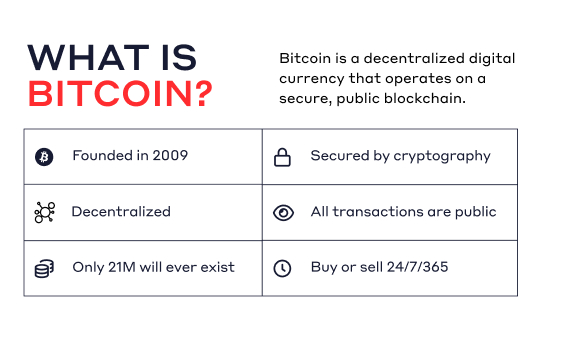
Bitcoin is a decentralized digital currency secured by blockchain technology. It was originally created by an anonymous entity named Satoshi Nakamoto. Nakamoto published a white paper in 2008 that described how Bitcoin works, and the project has been community-run since 2010.
While governments and central banks control traditional money, like dollars, euros, and yen (fiat currencies), Bitcoin isn’t “owned” by a single group. Instead, volunteer developers and Bitcoin holders work together to update and improve the open-source software behind the Bitcoin network. Anyone can buy or sell Bitcoin semi-anonymously using a digital wallet, and anyone can become a miner to help process transactions.
Bitcoin offers a unique combination of security, efficiency, and self-governance that has led many to view it as a form of “digital gold”[1] and a significant development in the evolution of money.
Why Was Bitcoin Created?
In the original Bitcoin whitepaper, Nakamoto wrote that “a purely peer-to-peer version of electronic cash would allow online payments to be sent directly from one party to another without going through a financial institution.”[2]
Based on the principles the paper described, Bitcoin was created to offer a currency that’s controlled by its users rather than a government, central bank, or financial institution[3] . This idea of monetary sovereignty, where users fully control their own money, can be especially appealing to privacy advocates.
Blockchain software is designed to be transparent and secure. Here’s how:
● Anyone can look up any transaction that’s ever been made since the blockchain’s inception.
● Past transactions can’t be edited.
● New transactions are validated through a consensus process run by participants scattered across the world.
The rise of Bitcoin and other cryptocurrencies coincides with a range of economic and social events. For example, the 2008 financial crisis led many to lose trust in traditional banking. In the years since, inflation has challenged the purchasing power of many national currencies.
Because of the monetary sovereignty it offers, Bitcoin has attracted users and advocates from all corners of the globe who see value in a decentralized system designed to operate outside traditional financial structures.
How Does Bitcoin Work?
One of Bitcoin’s major benefits is its unique approach to security and transparency.
At the center of the system is the blockchain, a secure, shared record of transactions. Once a transaction is added to the blockchain, it can’t be deleted or edited.
While blockchain transactions are semi-anonymous, anyone can view the entire history of every Bitcoin ever created. Because of this open, shared structure, blockchains are often referred to as distributed ledgers.
New transactions are grouped into bundles called blocks. Bitcoin miners, which are computers that track and process transactions, compete to solve complex cryptographic puzzles. The first miner to solve each puzzle adds the new block (transaction) to the blockchain. The update is shared with all other miners, who then begin working on the next block.[4] [5]
To buy, send, and receive Bitcoin, users need a compatible Bitcoin wallet. Bitcoin wallets come in two main types:
● Hardware wallets (cold storage), which are physical devices that store Bitcoin offline
● Software wallets (hot storage), such as desktop apps or web browser plugins
Bitcoin wallets have two digital keys:
● The public wallet address, which is used for receiving Bitcoin
● The private signing key, which is used to virtually unlock the wallet and send currency to other digital wallets[6]
Bitcoin’s design also includes a fixed supply, which is critical to understanding how it works. Only 21 million Bitcoins will ever exist. This predictable supply is a defining feature of Bitcoin’s economic model and a major point of interest for many users and researchers who study its long-term behavior.[7] [8]
How Bitcoin Mining Works
We’ve referenced Bitcoin mining several times so far, but there are important details worth exploring. Here’s a deeper look at how Bitcoin mining works. The algorithms behind Bitcoin use a system called proof-of-work (PoW), where Bitcoin miners compete in a virtual lottery to earn Bitcoin. The first miner to validate a new block of transactions is awarded newly created (or “mined”) Bitcoin, as well as fees paid by users who submitted new transactions. New Bitcoins will continue to be created until the 21 million limit is reached.
Over time, the mining reward is cut in half during events called “halvings,” which slow the release of new coins. Bitcoin miners are simply computers working to verify and approve new transactions. Technically, almost any device can act as a miner, including a smartphone, old laptop, large computer server, or specialized Bitcoin mining hardware. As miners work, they help the network reach consensus on which transactions are valid. Transactions are added to new blocks in the order they’re received, and strict rules ensure only legitimate blocks are accepted. Because all miners must agree on new blocks, it’s nearly impossible to add fraudulent transactions or change past ones.[9] [10]
All of this is powered by advanced cryptographic algorithms. Yes, that’s cryptography like in spy movies. Except here, it’s used in the “proof-of-work” system behind the blockchain. Due to the nature of mining, the most efficient machines are purpose-built miners. The current best-in-class system is ASIC (application-specific integrated circuit) computer chips, which are much faster than the recent favorite, GPU (graphics processing unit) chips. While you can mine Bitcoin with an old computer you have lying around the house, the energy cost is likely to outweigh the rewards. That’s why professional mining operations like American Bitcoin use the latest ASIC infrastructure and low-cost energy sources to maximize return on investment (ROI).[11] [12] [13]
Bitcoin 101: Core Features Explained[14]
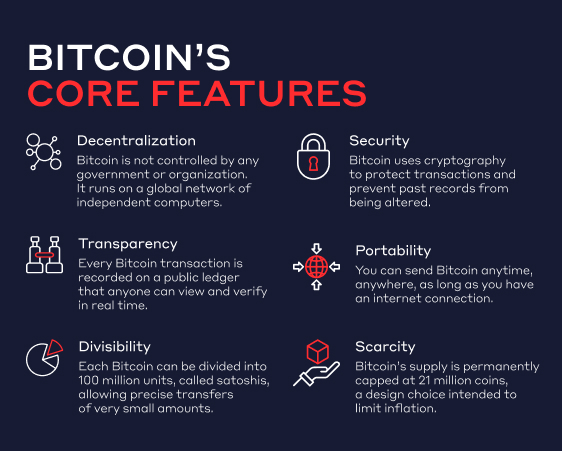
Bitcoin has several defining characteristics that set it apart from traditional forms of money. Understanding these core features helps explain how the system works and why many people find it compelling.
Decentralization
No government, corporation, or individual controls the Bitcoin network. Instead, the rules are determined by computer code, and any changes require agreement from a majority of users. Instead of relying on a central operator, Bitcoin operates on thousands of independent users in many different countries, with the United States recognized as one of the leading hubs for mining activit[15] y.[16] [17]
Transparency
Every Bitcoin transaction is recorded on a public ledger that anyone can audit at any time. Because transactions and wallets all have unique, public identifiers, anyone can search by wallet or transaction to find all historical details. Many websites and apps allow users to search the Bitcoin blockchain using those public identifiers. If you know a public wallet address, you can look up its transaction history and current balance. This transparency can be helpful for accountants, analysts, and law enforcement for any number of use cases.[18] [19]
Anyone, you included, can verify transactions, balances, and the overall supply in real time.
Security
The Bitcoin blockchain is secured through several layers of protection:
● Thousands of computers independently verify activity
● Past transactions can’t be edited
● Advanced cryptographic algorithms ensure accurate and transparent activity
As long as users follow cybersecurity best practices, their Bitcoin holdings may be as safe as any other asset worldwide, including physical gold and U.S. dollars in the bank.To send Bitcoin from a wallet, users must have the private key associated with that wallet. As long as private keys are stored safely, only the owner can authorize transactions[20] [21] .
Portability and Divisibility
Sending $500 in cash or bank funds usually requires intermediaries like banks, payment processors, or wire services, many of which charge fees or reduce privacy. With Bitcoin, you can send funds to any wallet in just a few clicks. Most transactions confirm within about 10 minutes[22] , though busy periods may take longer.
Bitcoin is also highly divisible, meaning you can send less than a full Bitcoin when needed. Each Bitcoin is divided into 100 million units, just like one U.S. dollar is divided into 100 cents—but with a lot more zeroes. Each one hundred millionth of a Bitcoin is called a satoshi, named after the currency’s creator.[23] [24]
Scarcity
New Bitcoins are created when miners successfully add new blocks to the blockchain. Bitcoin miners will continue to be rewarded with new Bitcoin until the hard limit of 21 million coins is reached. After that, the full supply will have been mined, and no new coins will be created.
Because Bitcoin is a scarce resource, it tends to hold its value. In fact, the value may increase faster once the supply cap is reached, particularly as lost wallets further limit supply.
Safely Storing Bitcoin
Businesses and individuals using Bitcoin should follow strict security practices to keep their digital assets safe while ensuring they remain accessible when needed.
Consider these tips to stay safe:
● Use hot wallets cautiously. Hot wallets (ones in an app or website) are convenient for everyday transactions but are more exposed to online risks. For longer-term storage, many users rely on cold wallets (physical hardware), which use private keys completely offline.
● Keep your devices updated. Keep your operating system and apps updated to ensure the latest security fixes are installed across all of your devices.
● Avoid public Wi-Fi. Never send crypto using a public Wi-Fi network. Adding a VPN can provide extra protection any time you’re dealing with digital assets.
● Use strong security credentials. Use strong, unique passwords for every digital account. Implement multifactor authentication wherever supported, especially on your email and financial accounts.
● Know who holds your crypto. Bitcoin can be held directly in a personal wallet or through a service like an exchange or custodian. Each approach has different responsibilities and tradeoffs, so it’s important to understand how custody works and who controls the private keys.
● Protect your recovery phrase. If you lose access to a digital wallet, you’re not completely out of luck. When creating a new wallet, you’re given a backup recovery phrase, a series of words you can use to restore your wallet. Keep that in a safe place where only you, and perhaps a trusted friend or relative, have access.
Common Bitcoin Myths and Misunderstandings[25]
As with any new and exciting technology, Bitcoin has inspired a wide range of myths and misconceptions. Here’s a look at some of the most common ones:
Bitcoin isn’t real money: Bitcoin may not exist as paper bills or metal coins, but people and businesses use it every day to send and receive payments, store value, and move money across borders. It has a market price, can be divided into smaller units, and is accepted by merchants and financial institutions, which are all hallmarks of money.
Bitcoin is anonymous: Bitcoin is better described as semi-anonymous. Wallet addresses are not tied to your name by default, but every transaction is recorded on a public ledger. That means activity can be traced and sometimes linked back to real people or organizations.
Bitcoin is bad for the environment: Bitcoin mining does use energy, which raises valid questions. At the same time, many miners seek low-cost renewable power, use otherwise wasted energy, and invest in increasingly efficient hardware, which can reduce the overall environmental impact over time.
Bitcoin can be hacked: The Bitcoin network itself has not been successfully hacked since it launched. Most “crypto hacks” involve exchanges, wallets, or other third-party services that did not follow strong security practices.
You need a lot of money to get started: You do not have to buy a full Bitcoin to participate. Because each Bitcoin is divisible, many beginning investors start with a small amount that fits comfortably in their budget and overall strategy.
Bitcoin is only for criminals: While some criminals have used Bitcoin, the same is true for cash and bank accounts. Today, most Bitcoin activity takes place on regulated platforms for legitimate use cases, including cross-border payments, long-term investing, and corporate treasury strategies.
Ready to Join the Digital Currency Revolution?
Learning what Bitcoin is, why it matters, and how it works can help you decide how you want to engage with the broader world of digital assets. As Bitcoin adoption grows, so does the need for strong, dependable infrastructure to support the network.
American Bitcoin Corp (Nasdaq: ABTC) is working to build that backbone for the United States, both by accumulating Bitcoin as a long-term asset and by developing the infrastructure that helps support a healthy Bitcoin ecosystem.
Learn more about ABTC’s approach to Bitcoin mining and accumulation.
What Is Bitcoin? FAQs
Who created Bitcoin?
Bitcoin was created by Satoshi Nakamoto. Not much is known about Nakamoto, and it may actually be a pseudonym. Some have speculated they are a software and cryptography expert from the United States or Europe, and several names have been floated as potentially being the true person(s) behind the name.
What is blockchain technology?
Blockchain technology is a type of distributed database and ledger software. With blockchain technology, a copy of the same ledger is stored, updated, and verified by many computers, building a system of trust and security for all users.
What is a Bitcoin wallet?
A Bitcoin wallet is a software application or hardware device that stores the public and private key pair used to store and transact with Bitcoin. You can access a single Bitcoin wallet using multiple software or hardware wallets, even at the same time, so it’s important to keep your wallet information private and secure.
How is Bitcoin different from regular money?
Unlike “regular” money controlled by governments, Bitcoin is a decentralized currency. No single country, central bank, or corporation controls Bitcoin. Bitcoin ownership is verified using Bitcoin wallet addresses and a public database of transaction history. While you can own, send, and receive it like cash, you don’t need an actual bank to manage your Bitcoin.
What is Bitcoin mining?
Bitcoin mining is a computerized process of verifying and processing new Bitcoin transactions. Computers around the world compete to solve a proof-of-work algorithm. The first miner to solve the algorithm is rewarded with new Bitcoin and transaction fees from users. Anyone can mine for Bitcoin, including individuals at home and large companies operating Bitcoin mining warehouses.
How do Bitcoin transactions work?
Bitcoin transactions take place on the Bitcoin blockchain. When a user submits a transaction to send Bitcoin, the wallet’s public address and private key are verified to ensure it’s a valid and approved transaction. It’s then bundled with other transactions into a block and processed as a group by Bitcoin miners. After approval, the transaction is listed on the blockchain, and the recipient can view and access the Bitcoin in their wallet.
Can Bitcoin be hacked?
While some individual wallets and exchanges have been hacked, the Bitcoin network overall is extremely resilient. While any software could potentially be hacked or fall victim to vulnerabilities, the Bitcoin network has never been breached, and countless developers around the world keep an eye on the code to ensure it remains secure.
Why is Bitcoin valuable?
Bitcoin is a digital asset with a limited supply. There will only ever be 21 million Bitcoin, and most of it is already mined. Its fixed supply, global accessibility, and decentralized design contribute to ongoing demand from individuals and institutions.
What makes Bitcoin secure?
The blockchain database behind Bitcoin is unable to ever be edited, so we have a full history of all transactions from the inception of the currency. New transactions can only be added through the consensus of thousands of computers, making all transactions highly secure and verifiable.
How many Bitcoins will ever exist?
The maximum number of Bitcoins to ever exist is 21 million. After the last Bitcoin is mined, the computers responsible for Bitcoin mining will only be paid in transaction fees.
Sources
● How Does Bitcoin Work? Bitcoin.org. https://bitcoin.org/en/how-it-works
● Bitcoin: A Peer-to-Peer Electronic Cash System. Satoshi Nakamoto. https://bitcoin.org/bitcoin.pdf
● Risks to consumers posed by virtual currencies. Consumer Financial Protection Bureau. https://files.consumerfinance.gov/f/201408_cfpb_consumer-advisory_virtual-currencies.pdf
● Bitcoin Mining by Country 2025. World Population Review. https://worldpopulationreview.com/country-rankings/bitcoin-mining-by-country
● What is Blockchain Security? IBM. https://www.ibm.com/think/topics/blockchain-security
[1]https://www.db.com/what-next/digital-disruption/dossier-payments/i-could-potentially-see-bitcoin-to-become-the-21st-century-gold?language_id=1
https://www.sciencedirect.com/science/article/abs/pii/S2405851324000254
If Bitcoin is sometimes called “digital gold”,
[2]A purely peer-to-peer version of electronic cash would allow online
payments to be sent directly from one party to another without going through a
financial institution.
https://bitcoin.org/bitcoin.pdf
[3]https://comptroller.texas.gov/economy/fiscal-notes/archive/2018/april/bitcoin.php
This artificial scarcity controls the supply of bitcoins, a job central banks such as the Federal Reserve handle for conventional currency. Bitcoin was designed to have a fixed total circulation of 21 million. To ensure this, the complex computer algorithms needed to create bitcoins are becoming more difficult over time. “Mining” that could once be accomplished on a personal computer now requires huge data centers.
[4]https://www.ibm.com/think/topics/blockchain
With each new block, the blockchain becomes more secure, making it nearly impossible to change past transactions. This immutability provides a trusted, transparent ledger that all network members can rely on, preventing fraud and ensuring that all transaction records are accurate and unchangeable.
Consensus among network members is required to validate data accuracy, and all validated transactions are immutable and permanently recorded. This capability guarantees that no transaction can be deleted, even by a system administrator.
All network participants have access to the distributed ledger and its immutable record of transactions. This shared ledger records transactions only once, eliminating the duplication of effort typical of traditional business networks.
[5]In blockchain technology, each transaction is grouped into blocks, which are then linked together, forming a secure and transparent chain. This structure guarantees data integrity and provides a tamper-proof record, making blockchain ideal for applications like cryptocurrencies and supply chain management.
The key benefit of blockchain lies in its ability to provide security, transparency and trust without relying on traditional intermediaries, such as banks or other third parties. Its design reduces the risk of fraud and errors, making it especially valuable in industries where secure transactions are critical, including finance and healthcare. In addition, blockchain helps businesses improve efficiency and reduce costs by streamlining processes and enhancing accountability.
[6]https://bitcoin.org/en/how-it-works#:~:text=Bitcoin%20wallets%20keep%20a%20secret,once%20it%20has%20been%20issued.
Once you've installed a Bitcoin wallet on your computer or mobile phone, it will generate your first Bitcoin address and you can create more whenever you need one.
The block chain is a shared public ledger on which the entire Bitcoin network relies. All confirmed transactions are included in the block chain. It allows Bitcoin wallets to calculate their spendable balance so that new transactions can be verified thereby ensuring they're actually owned by the spender. The integrity and the chronological order of the block chain are enforced with cryptography.
A transaction is a transfer of value between Bitcoin wallets that gets included in the block chain. Bitcoin wallets keep a secret piece of data called a private key or seed, which is used to sign transactions, providing a mathematical proof that they have come from the owner of the wallet. The signature also prevents the transaction from being altered by anybody once it has been issued. All transactions are broadcast to the network and usually begin to be confirmed within 10-20 minutes, through a process called mining.
[7]https://www.ey.com/en_ch/insights/blockchain/the-bitcoin-halving-explained#:~:text=At%20this%20point%20in%20time,mined%20around%20the%20year%202140.
https://coinmarketcap.com/currencies/bitcoin/
[8]At this point in time, there are about 19.5 million Bitcoins that have already been mined, while the maximum supply is fixed at 21 million Bitcoins.
The event, integral to maintaining Bitcoin’s value through scarcity, could shape its market value, mining operations, and profitability.
[9]https://bitcoin.org/en/how-it-works#processing
[10]Mining is a distributed consensus system that is used to confirm pending transactions by including them in the block chain. It enforces a chronological order in the block chain, protects the neutrality of the network, and allows different computers to agree on the state of the system. To be confirmed, transactions must be packed in a block that fits very strict cryptographic rules that will be verified by the network. These rules prevent previous blocks from being modified because doing so would invalidate all the subsequent blocks. Mining also creates the equivalent of a competitive lottery that prevents any individual from easily adding new blocks consecutively to the block chain. In this way, no group or individuals can control what is included in the block chain or replace parts of the block chain to roll back their own spends.
[11]Q for ABTC: Is this type of "promotional" language okay to use in our content?
[12]Scroll down to the Mining section
[13]Focus growth capital on scaling exahash and compounding Bitcoin-per-share growth.
[14]Rich media: Infographic summarizing Bitcoin's key features
E.g. https://i.pinimg.com/736x/1b/e5/da/1be5daa4b120fe47142bcfdbe6054e4e.jpg
[15]More recent data that corroborates (also, removing the country-by-country percentages helps keep it evergreen): https://hashrateindex.com/blog/global-hashrate-heatmap-update-q4-2025/
[16]https://worldpopulationreview.com/country-rankings/bitcoin-mining-by-country
[17]United States: 37.84%
China: 21.11
Kazakhstan: 13.22%
Canada: 6.48%
Russia: 4.66%
Germany: 3.06%
Malaysia: 2.51%
Ireland: 1.97%
Thailand: 0.96%
Sweden: 0.84%
[18]https://blockstream.info/
https://www.chainalysis.com/
[19]Blockstream.io shows how you can run searches using identifiers.
[20]https://bitcoin.org/bitcoin.pdf
https://www.ibm.com/think/topics/blockchain-security
[21]The transactions section on page 2 of the bitcoin link has a graphic showing private keys.
[22]https://coinmarketcap.com/academy/article/how-long-does-a-bitcoin-transaction-take
On the Bitcoin network, the average confirmation time for a BTC payment is about 10 minutes.
[23]https://www.kraken.com/learn/what-are-bitcoin-satoshis-sats
[24]Named after the pseudonymous creator of Bitcoin, Satoshi Nakamoto, a satoshi represents one hundred millionth of a bitcoin (0.00000001 BTC).
[25]Note to ABTC: This would be a good section to weave in a quote from an SME at ABTC